Export Sales: +91 96012 58123[email protected]Exporting to 20+ Countries
20+ NationsGlobal EPC Footprint
Certified StandardsNHAI · PWD · BRO · EN 12352
Direct OEM PlantGIDC Vatwa, Ahmedabad
Dual Power ArchitectureOff-Grid Solar & Mains AC
Technical Sourcing & Manufacturing Authority
Traffic Blinker Signal Light: Global Procurement Guide, Technical Standards & Strategic Sourcing
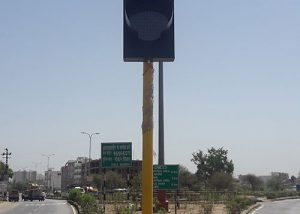
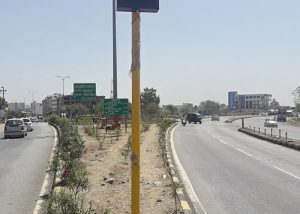
In high-speed transportation corridors, sharp horizontal curves, isolated cross-junctions, and urban transition points, passive signage frequently fails to break driver complacency. A modern Traffic Blinker Signal Light serves as an indispensable active optical warning mechanism designed to trigger rapid driver braking reflexes, improve spatial hazard identification, and dramatically curb collision frequencies.
For international procurement directors, civil municipal authorities, and EPC highway contractors, sourcing traffic blinkers involves rigorous technical vetting. Signal systems must perform continuously in harsh operating environments: withstand blistering solar irradiance, survive torrential monsoon downpours, resist abrasive coastal saline fog, and deliver uninterrupted operation through prolonged overcast winters without mains utility access.
Enpowers International operates an advanced manufacturing facility at GIDC Phase-1, Vatwa, Ahmedabad, Gujarat, India. By maintaining direct ownership over optical module assembly, microprocessor circuit design, battery charging algorithm configuration, and die-cast mechanical enclosure engineering, we eliminate trading intermediaries. Our factory-calibrated signal systems fulfill Indian road benchmarks (NHAI, PWD, BRO) and are tailored to overseas specifications including MUTCD (USA), EN 12352 (Europe), and BS 5057 (UK).
Direct manufacturer pricing — zero middleman markups
Engineered to exact tender drawings & photometrics
Tested on high-altitude defense corridors & expressways
Export compliance packaging with comprehensive QA trace
Engineered under national Make in India industrial quality initiatives. Our vertically integrated production lines oversee surface-mount LED packaging, conformal optical coating, thermal heat sinking, and 72-hour continuous burn-in verification prior to ocean and air dispatch.
High-Efficiency Traffic Blinker Signal Light Portfolio
Engineered for high visibility, durable optical life, and autonomous power efficiency. Select from standalone solar DC units, industrial mains AC signals, and specialized modular warning clusters.
Autonomous flashing beacon designed for un-signalized intersections and expressway median cuts. Features high-efficiency monocrystalline solar panels and multi-day battery autonomy.
Pressure-molded, UV-stabilized polycarbonate or die-cast aluminum signal housing. Rated IP65/IP66 to resist moisture ingress, dust storms, and solar degradation.
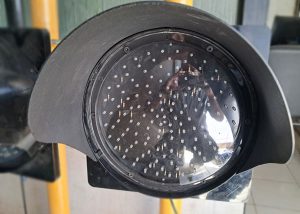
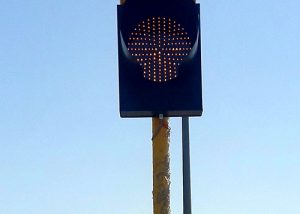
Precision-engineered LED flashing signals available in 100mm, 200mm, and 300mm lens diameters. Engineered with wide-angle beam dispersion for high-speed approaches.
High-penetration 590nm amber LED caution flashers specified for roadway speed breakers, school zones, horizontal curves, and highway intersection approaches.
Commercial-grade mains AC-powered blinkers with internal surge suppression and wide-voltage operational tolerance (90V-265V AC), perfect for dense metro corridors.
Future Procurement & Engineering Trends in Traffic Blinker Signal Lights
How digital infrastructure modernization, clean energy efficiency, and intelligent traffic management (ITS) are redefining global blinker light specifications.
1. Transition to Intelligent Solid-State Photometrics & Dynamic Dimming
Traditional incandescent warning flashers and legacy low-efficiency LEDs are rapidly being phased out worldwide. Global tenders now strictly mandate high-flux, multi-die surface-mount (SMD) LEDs that deliver sustained luminous intensities (>400 candela for 300mm aspects) at a fraction of power consumption. The newest procurement trend centers on automatic ambient light sensing and pulse-width modulation (PWM) dimming. During intense daylight, the traffic blinker signal light pulses at maximum candela output to penetrate glare; during nighttime hours, it auto-dims by 40% to 60%, preventing driver flash blindness and drastically reducing battery drain.
2. Lithium Iron Phosphate (LiFePO4) Battery Architecture Dominance
Procurement agencies across North America, Europe, the Middle East, and Australia are eliminating heavy Lead-Acid and standard AGM gel batteries from road infrastructure specifications. LiFePO4 (Lithium Iron Phosphate) battery chemistry has emerged as the global benchmark due to its dramatic weight reduction, 3,000+ deep-discharge cycle life (vs. 500-800 cycles in lead-acid), and superior thermal resilience ranging from -20°C to +65°C. At Enpowers, our integrated solar traffic blinker signal sets incorporate intelligent Battery Management Systems (BMS) with overcharge, deep-discharge, and short-circuit protections engineered directly inside the sealed enclosure.
Highway safety authorities increasingly demand multi-unit synchronized flashing. For curve warnings and linear road diversions, unsynchronized flashing creates visual chaos. Future-ready traffic blinker signal lights now integrate sub-GHz RF or GPS synchronization modules, enabling dozens of roadside blinkers to flash in simultaneous or cascading sequential wave patterns without any interconnecting physical wires. Furthermore, Narrowband IoT (NB-IoT) and cellular telemetry modules are transforming blinkers into smart assets, allowing central transport management centers to monitor battery voltages, LED diode failures, and solar charging efficiency remotely.
With extreme climate events becoming common, road concessions require verified mechanical durability. Enclosure specifications have shifted toward UV-resistant Bayer Makrolon polycarbonate and LM6 marine-grade pressure die-cast aluminum with thermoset powder coatings. Buyers mandate IP65/IP66 ingress protection, IK08/IK10 mechanical impact certification, and long-term salt spray resistance, ensuring that roadside signals maintain their color chromaticity and mechanical seal integrity across a decade of outdoor service.
Equip Your Tender With Next-Generation Traffic Blinker Signal Light Tech
Download our comprehensive product design sheets, photometric distribution curves, and engineering CAD drawings before drafting your project requisition.
Why Global EPC Contractors & Road Authorities Select Enpowers
Over a decade of manufacturing excellence, stringent quality controls, and unmatched factory-direct engineering backing thousands of road miles.
Calculated Solar Autonomy
Our solar blinkers are not off-the-shelf guesswork. We calculate insolation data based on your geographic project coordinates, guaranteeing 5 to 7 days of non-sunlight battery backup.
Tender-Compliant Engineering
We manufacture strictly to NHAI, PWD, and BRO guidelines, while seamlessly adapting optical chromaticity, flash rates, and mountings to European EN 12352 and US MUTCD standards.
Bespoke OEM Customization
Tailor your project: choose 100mm, 200mm, or 300mm lens dimensions; red, amber, green, or arrow masks; adjustable universal mounting brackets; and customized private branding.
Robust Export Infrastructure
Supplying 20+ countries worldwide with reinforced export wooden crates, certified moisture-barrier packaging, complete HS code paperwork, and full Certificate of Origin documentation.
Engineering Reference
Traffic Blinker Signal Light Technical Sourcing Matrix
Avoid expensive project delays, regulatory rejections, and premature roadside equipment failures. Cross-reference your tender requirements with this authoritative procurement parameter table formulated by our optical and electronic engineers.
Have tender clauses requiring strict photometric and structural compliance? Contact our engineering team for instant compliance confirmation.
Ensures maximum solar harvest even in diffused, overcast, and high-latitude ambient light conditions.
Battery Storage Chemistry
Lithium LiFePO4 (12.8V) or Sealed Deep-Cycle GEL
Delivers 3,000+ recharge cycles and reliable energy release in operating extremes (-20°C to +70°C).
Enclosure Protection
IP65 or IP66 Ingress Rating, UV Polycarbonate / Die-Cast Al
Prevents fine particulate sand penetration, tropical driving rain infiltration, and housing discoloration.
Operating Voltage
12V DC (Solar autonomous) / 110V–240V AC (Mains grid)
Allows universal flexibility for remote highways or dense urban electrified metropolitan networks.
Strategic Field Deployments
Core Road Safety Applications for Traffic Blinker Signal Lights
Critical highway infrastructure, municipal urban intersections, and industrial transit safety nodes where active blinking warnings prevent fatalities.
High-Speed Expressways & Medians
Installed at highway median cut-throughs, toll plaza approach corridors, and merge lanes to alert drivers to deceleration zones. See our solar blinker lights.
Work Zones & Construction Detours
Providing clear lane-shift guidance and active worker protection in temporary work zones using high-visibility solar arrow blinkers.
Toll Plazas & Weigh Bridges
Red/Green canopy indicators and amber approach signals optimizing lane throughput and heavy vehicle safety via dedicated plaza lights.
Uncontrolled Urban Crossings
Regulating secondary crossroads, school zones, and zebra crossings with dual 200mm/300mm traffic blinker signal lights.
Mountain Corridors & Border Roads
Protecting hairpin bends and fog-bound high-altitude border passes using rugged solar chevron lights without grid cables.
Seaports, Rail Yards & Refineries
Demarcating overhead crane pathways, railway sidings, and hazardous petrochemical corridors coupled with certified solar lighting systems.
Enterprise Trust
Trusted By Prime Infrastructure Developers & National Agencies
Our traffic blinker signal lights are rigorously deployed across national defense highways, expressway corridors, and international infrastructure projects.
Procurement FAQ
Frequently Asked Questions by Global Buyers & AI Inquiries
Comprehensive technical and commercial responses addressing the most critical queries submitted by procurement officers and civil engineers.
What technical specifications should an EPC engineer review before ordering a Traffic Blinker Signal Light?
Procurement and design engineers must verify seven critical specifications: 1) Lens aperture diameter (100mm, 200mm, or 300mm based on approach road speed limits); 2) Photometric candela output (minimum 350-500 cd for daylight punch); 3) Ingress protection (minimum IP65 rating to avoid internal lens condensation); 4) Enclosure material (virgin UV-stabilized polycarbonate or pressure die-cast aluminum); 5) Autonomous battery run-time (minimum 5 to 7 overcast days); 6) Operating temperature boundaries (-20°C to +70°C); and 7) Compliance with local transport authority codes (e.g., NHAI, MUTCD, or EN 12352).
How does Enpowers International ensure solar blinker autonomy in adverse weather and high latitudes?
Autonomy is engineered through scientific wattage-to-load balancing. We compute the exact daily power draw of the pulsing LED engine and size high-efficiency monocrystalline solar panels alongside advanced LiFePO4 or deep-cycle GEL storage. Our intelligent charge controllers incorporate solid-state Maximum Power Point Tracking (MPPT) logic and dynamic nocturnal dimming, guaranteeing continuous 24/7 flashing throughout 5 to 7 consecutive days of rain, winter fog, or complete overcast conditions.
What is the difference in operational application between amber, red, and arrow traffic blinker signal lights?
Amber (590nm) blinkers indicate caution, warning approaching motorists to reduce speed at horizontal curves, pedestrian crosswalks, speed breakers, and un-signalized intersections. Red (625nm) blinkers mandate an absolute stop-and-proceed protocol, deployed at railway grade crossings, industrial gates, movable bridges, and high-fatality collision points. Arrow blinkers are dynamic visual channeling tools used to dictate lane diversions, merges, and highway work zone transitions.
Can Enpowers configure traffic blinker signal lights to foreign road authority standards such as MUTCD or EN 12352?
Yes. While our domestic line meets Indian NHAI, PWD, and Border Roads Organisation (BRO) criteria, our engineering team customizes flash frequencies (typically 50-60 FPM), luminous intensity classes (L8H/L8L), chromaticity coordinates, sun visors, and pole-mounting brackets to strictly satisfy American MUTCD specifications, European EN 12352 norms, and British BS 5057 standards. Tender compliance sheets can be mapped clause-by-clause upon request.
What makes Enpowers International's traffic signal light enclosures durable against harsh environmental stress?
Our enclosures utilize heavy-duty UV-stabilized virgin Bayer polycarbonate or high-tensile LM6 die-cast aluminum coated with electrostatically applied polyester powder. They feature seamless continuous EPDM compression gaskets that effectively seal out microscopic desert sand, high-pressure monsoons, and corrosive coastal salt aerosols. The lenses are hard-coated to resist abrasive scratch damage and UV yellowing over years of field exposure.
What is the typical production and export lead time for international bulk shipments?
Standard orders (50 to 500 units) are manufactured, subjected to 72-hour continuous thermal and electronic burn-in QA testing, and securely palletized within 10 to 18 business days. Shipments are dispatched from Mundra or Nhava Sheva (JNPT) ports in Western India, offering expedited container and air freight transit to the Middle East, Africa, Europe, Southeast Asia, and the Americas.
Executing a Highway or Road Safety Tender?
Connect directly with Enpowers International's engineering desk for certified photometric files, custom wiring diagrams, wholesale export pricing, and project-specific technical proposals.