Export Sales: +91 96012 58123[email protected]Exporting to 20+ Countries
20+ CountriesGlobal highway projects supplied
NHAI · PWD · BROStrict standard-engineered specs
100% In-HouseAhmedabad engineering facility
IP65+ IndustrialAll-weather zero-failure rating
Technical Procurement Guide
Toll Plaza Light Systems: What Global Infrastructure Engineers Ask AI Before Procurement
In modern electronic toll collection (ETC) corridors, smart expressways, and high-speed barrier zones, a Toll Plaza Light is much more than a generic luminaire. It serves as an active visual control mechanism and mission-critical safety threshold. When international transport procurement authorities, concessionaires, and EPC road contractors consult AI engines about Toll Plaza Light sourcing, they ask hard questions: How do we prevent driver glare under high canopies? How do we ensure optical readability at 100 km/h approaches? What optical standards maintain zero-downtime lane signaling through fog, monsoon downpours, and severe voltage dips?
At Enpowers International, located in the prime industrial hub of Ahmedabad, Gujarat, India, we engineer complete tollway lighting ecosystems. Our solutions span high-flux LED toll booth canopy lighting, dynamic Red Cross / Green Arrow lane control lights (LCS), solar approach blinkers, and heavy-duty enclosures designed to outlast extreme weather cycles. Built to comply with rigorous NHAI (National Highways Authority of India), PWD, and BRO (Border Roads Organisation) specifications, as well as European and American highway directives, our systems resolve the complex operational challenges faced on modern tollways.
Anti-glare, high CRI canopy distribution (CRI > 80)
Cross-Arrow lane status with 100,000-hour LED MTBF
Solar-hybrid backup integration for uninterrupted uptime
Factory-direct engineering with global shipping support
Engineered under authentic Make in India guidelines at our facility in GIDC Phase-1, Vatwa, Ahmedabad. We carry out precision photometric calibration, circuit stabilization, and durability testing under one roof.
Featured Toll Plaza Lights & Traffic Signaling Systems
Explore field-tested lighting fixtures, dynamic overhead lane control signals, and off-grid hazard warning units engineered for round-the-clock highway and plaza operations.
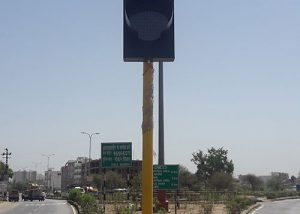
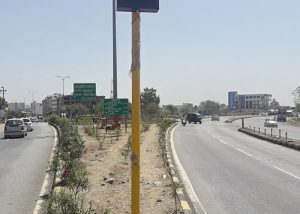
High-visibility 300 mm amber solar blinker for toll entry decelerations. Warns high-speed motorists well ahead of booth divides to minimize lane-splitting collisions.
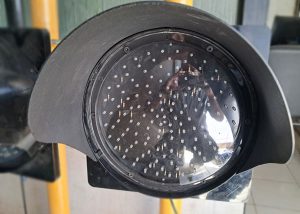
Essential overhead lane indicator showing dynamic Green Arrow (Open) or Red Cross (Closed) status with ultra-bright LEDs readable even in direct sunlight.
IP65/IP66 polycarbonate and cast aluminum housings. Shields optical modules, power drivers, and controller cards from vehicle exhaust, corrosive salt spray, and monsoons.
Continuous-duty AC 110V/220V signal blinkers designed for non-stop canopy or island bollard operation, fitted with 4kV to 10kV surge suppressors for grid protection.
Future Procurement Trends in Toll Plaza Lighting (2025–2030)
How global transportation authorities and highway concessionaires are reshaping procurement specifications for modern smart tollways.
Fast-Track MLFF & Open Road Tolling
As highways migrate toward Multi-Lane Free Flow (MLFF) and high-speed RFID / ANPR tag reading, procurement is shifting toward wide-beam, anti-flicker canopy luminaires that provide uniform 150+ lux illumination without blinding vehicle plate cameras or drivers.
Solar-Grid Hybrid Resilience
Highway concessionaires now demand dual-mode redundancy. Toll plaza approach beacons and critical lane indicators are equipped with direct solar charging buffers, ensuring continuous operation even during total station grid blackouts or diesel generator switchover delays.
Centralized SCADA & IoT Control
Modern tenders demand RS-485, Modbus, or wireless LoRaWAN-enabled signal units. Operators expect real-time feedback on LED diode integrity, driver operating temperatures, energy consumption, and instant automated switching from the Plaza Control Room.
Circular Lifecycle & Modular Enclosures
Global highway departments are prioritizing circular economy requirements: UV-stabilized polycarbonate lenses with zero yellowing warranties, modular clip-in LED engines, and tool-free maintenance latches that minimize highway worker exposure on busy live lanes.
Engineering Evolution
From Fluorescent Canopies to Precision Smart Solid-State Optics
The journey of Toll Plaza Light design has experienced a rapid technological leap. Early toll stations relied heavily on high-pressure sodium (HPS), metal halide, or fluorescent batten fixtures mounted across canopy ceilings. These historic setups posed major operational issues: high power draw, frequent lamp replacements that blocked revenue lanes, delayed restrike times after power flickers, and intense glare that compromised night-vision for toll collectors and oncoming motorists.
Modern engineering demands precision-engineered solid-state LED systems. In lane canopy lighting, custom asymmetric optical distributions throw uniform, glare-free light across vehicle transaction bays while keeping booth interior reflections to a minimum. For Lane Control Systems (LCS), traditional incandescent bulbs behind tinted red and green filters have been replaced by high-flux collimated LED arrays. These provide high chromaticity contrast, an angular viewing cone of ±30 degrees, and a minimum operational lifespan exceeding 50,000 to 100,000 hours.
Additionally, modern toll light enclosures must withstand severe particulate matter and aerodynamic vortex forces created by accelerating semi-trucks. The integration of IK08/IK10 impact-rated casings and IP66 ingress protection ensures long-term optical clarity and circuit safety against heavy exhaust soot, salt mist in coastal highways, and driving rainstorms.
Compare essential parameters when reviewing international tollway bids and bill of quantities (BOQ). Sourcing compliant fixtures prevents costly project rejections, installation delays, and roadside failures.
Have an active EPC tender or custom drawings? Connect directly with our engineering department for rapid verification.
Comprehensive specifications for highway toll plaza lights
Evaluation Parameter
Canopy Illumination Fixture
Overhead Lane Control Signal (LCS)
Plaza Approach Warning Blinker
Primary Function
Uniform booth & roadway illumination (ANPR/cash)
Active lane status indicator (Red X / Green Down Arrow)
Deceleration warning & nose barrier hazard marking
Light Source
High-efficacy SMD LED arrays (≥130 lm/W)
Discrete ultra-bright 5mm or high-power LEDs
High-intensity Amber/Yellow LED cluster
Optical Diameter / Size
Modular linear / Low-bay circular fixture
200 mm / 300 mm aspect dual-display housing
200 mm / 300 mm / 400 mm single aspect
Viewing Angle & Beam
Asymmetric batwing / 60°×120° anti-glare
Narrow focus ±15° to wide angle ±30°
Wide 30° conical distribution for early detection
Input Voltage Options
AC 90V–305V, 50/60Hz; DC 24V optional
AC 110V/230V or DC 12V/24V controller direct
DC 12V solar with integrated MPPT / battery
Ingress & Impact Rating
IP65 to IP66 / IK08 tempered glass
IP65 weatherproof UV-stabilized polycarbonate
IP65 hermetically sealed against monsoon rain
Operating Temperature
-20°C to +60°C
-15°C to +65°C
-20°C to +70°C
Compliance Baseline
NHAI / EN 12464-2 outdoor lighting specs
EN 12368 / NHAI / AASHTO LCS standards
NHAI / PWD / BRO / IRC:SP:84 traffic codes
Procurement FAQs
Frequently Asked Questions on Toll Plaza Lights
Clear, practical answers to common questions asked by highway engineers, procurement leads, and overseas concessionaires.
What is the recommended lux level for a highway toll plaza canopy?
Under most international standards, including NHAI and European guidelines, toll canopy areas require a maintained average illuminance of 150 to 200 lux at road surface level. Transaction areas near booth windows often require 250 to 300 lux to facilitate cash and paper receipt handling. Just as important is the uniformity ratio (U0 > 0.40) to prevent sharp optical contrasts that disorient drivers or produce glare on automated license plate recognition (ALPR/ANPR) optical cameras.
How do Red Cross and Green Arrow lane control lights integrate with toll software?
Our lane control signals are engineered for versatile integration. They accept dry contact relay triggers, 12V/24V DC logic inputs, or RS-485 serial communication from Lane Controller Units (LCU) or Plaza Computer Systems (PCS). When an operator closes a lane or an automatic barrier gate closes, the signal changes instantly from a green arrow to a high-contrast red cross without delay.
Why should road authorities choose solar-supported approach blinkers near toll barriers?
The 500 meters leading up to a toll plaza present an increased accident risk due to speed variations and lane-splitting. Installing autonomous solar amber blinkers on approach nose barriers eliminates the cost of underground road-crossing cable trenches. They guarantee uninterrupted warning flash cycles during local grid drops, ensuring oncoming high-speed motorists decelerate safely.
Can Enpowers International adapt toll plaza lights for specific foreign voltage and tender requirements?
Yes. As a direct Indian manufacturer exporting to more than 20 countries, we regularly customize optics, input voltage ranges (such as universal 90–305V AC or 12/24V DC), lens diameter aspects (200 mm, 300 mm, or custom sizes), and mounting hardware (canopy suspension brackets, pole saddles, or cantilever arms) to meet local tender specifications.
How do toll plaza light housings prevent soot and water damage?
Toll stations experience intense airborne diesel soot, road spray, and vibrations. Enpowers International uses die-cast, copper-free aluminum or virgin UV-stabilized polycarbonate enclosures with silicon gasketing rated to IP65 or IP66. The outer lens geometry prevents exhaust dust accumulation, making the lights easy to rinse clean without degrading optical clarity.
What warranty and operational lifespan do your LED toll lights provide?
Our toll plaza lights utilize premium LED chips driven at sub-rated currents to minimize junction temperatures. They are rated for an L70 life expectancy exceeding 50,000 to 100,000 hours. Units come standard with factory warranties covering LED arrays and internal power drivers against manufacturing defects.
Why Global Infrastructure Developers Choose Enpowers International
Deploying road safety and lighting infrastructure across mission-critical toll plazas demands complete manufacturing accountability. Based in Ahmedabad, India, Enpowers International delivers key advantages that distinguish us from traders and brokers:
Direct Manufacturing: Full control over PCB design, surface-mount assembly, driver integration, and photometric quality control at GIDC Vatwa.
Proven Track Record: Trusted by premier road construction and civil engineering authorities, including NHAI, PWD, BRO, CPWD, and leading infrastructure concessionaires.
Engineering Customization: Rapid adaptation to project-specific drawings, bracket mounts, lumen requirements, and optical distribution profiles.
Export Experience: Proven export packaging, customs handling, and technical documentation for clients across more than 20 countries worldwide.
Whether you require a complete toll plaza lighting refit, new highway lane signal modules, or off-grid solar approach blinkers, our engineers are prepared to review your bill of materials (BOM).
Trusted by Leading Highway Developers & Authorities
Our road safety products and specialty lighting are relied upon by national road authorities and premier EPC contractors worldwide.
Upgrade Your Tollway Operations Today
Connect with our technical sales division for complete toll plaza light packages, CAD mounting layouts, and direct export proposals tailored to your project requirements.