Core Range
Solar Traffic Signal Blinker
Our flagship autonomous warning signal for uncontrolled highway crossings, median nose protection, and hazard warning without trenching.
View details



Discover how autonomous solar green blinker lights deliver fail-safe lane affirmation, toll plaza efficiency, and off-grid traffic safety across international highway networks and heavy industrial complexes.
In contemporary civil transportation infrastructure and industrial perimeter management, traffic engineers and procurement authorities recognize that optical signaling is not merely about warning against hazards—it is equally about providing unambiguous, positive clearance affirmations. While the flashing amber beacon signifies caution and the flashing red signal commands an absolute stop, the Solar Green Blinker Light occupies a specialized, crucial function in global traffic psychology: it communicates active clearance, opened passage, designated bypass, and safe lane traversal without requiring an expensive utility grid connection.
An autonomous solar green blinker light combines a solid-state pure green LED optical cluster (dominant wavelength calibrated strictly between 505 nm and 525 nm for peak photopic human eye sensitivity), an integrated monocrystalline photovoltaic solar module, a high-density energy storage battery bank (such as LiFePO4 or heavy-duty cyclic gel VRLA), and an intelligent micro-controlled dusk-to-dawn charge controller. Because these systems are entirely self-contained, highway concessionaires, EPC infrastructure contractors, and logistics hub operators can deploy them in remote corridors, bypass toll approaches, port container checkpoints, and industrial gates within hours—eliminating thousands of dollars in asphalt trenching, underground conduit cabling, and grid transformer installations.
At Enpowers International, engineered at our dedicated production facility in Ahmedabad, Gujarat, India, every solar green blinker light is precision-tuned to maintain continuous visibility in intense equatorial direct sunlight as well as during persistent monsoon overcast. Built to conform with Indian standards (NHAI, PWD, CPWD, and IRC:67) as well as global norms (EN 12352 Class L8H and US MUTCD specifications), our systems empower infrastructure developers in more than 20 countries with zero-maintenance, round-the-clock lane management reliability.

Certified Made in India high-reliability engineering. Manufactured directly in GIDC Phase-1, Vatwa, Ahmedabad under strict ISO-compliant photometric and environmental quality assurance.

Compare standard engineering baselines for our 200 mm and 300 mm optical aspect units. Custom project adaptations are available for international tender criteria.
| System Parameter | 200 mm (8-Inch) Solar Green Blinker | 300 mm (12-Inch) Solar Green Blinker | Engineering Impact & Tender Relevance |
|---|---|---|---|
| Optical Aperture & Lens Diameter | 200 mm (±5 mm) Fresnel Clear Lens | 300 mm (±5 mm) Polycarbonate Geometric Lens | 300 mm is mandatory for expressway speeds exceeding 80 km/h; 200 mm is standard for urban gates and toll plazas. |
| LED Color & Wavelength | Pure Traffic Green: 505 nm – 525 nm | Pure Traffic Green: 505 nm – 525 nm | Prevents chromatic aberration and eliminates confusion with blue-green runway or marine navigation signals. |
| Luminous Intensity | ≥ 400 cd on axis (>80 high-flux LEDs) | ≥ 850 cd on axis (>180 high-flux LEDs) | Provides guaranteed optical legibility from 800m+ under intense 100,000 lux summer solar ambient wash. |
| Solar PV Generator | 15W – 20W Monocrystalline (Class A) | 40W – 50W Monocrystalline (High Yield) | Engineered with 30-degree tilt bracket to maximize solar collection efficiency across temperate and tropical zones. |
| Energy Storage Battery | 12.8V 12Ah LiFePO4 or 12V 18Ah Gel VRLA | 12.8V 24Ah – 30Ah LiFePO4 / 12V 40Ah Gel | Long cycle life (>2,500 cycles at 80% DOD for LiFePO4), non-spillable, fully maintenance-free operation. |
| Autonomy (No Sunlight) | Minimum 3 to 5 continuous days (72–120 hrs) | 5 to 7 continuous days (120–168 hrs) | Guarantees uninterrupted flashing through monsoons, sandstorms, and prolonged winter coastal cloud cover. |
| Flash Rate & Duty Cycle | 50 – 60 flashes/min (10% to 50% duty) | 50 – 60 flashes/min (Programmable) | Compliant with IRC:67 and international highway signaling standards to maintain optimum conspicuity. |
| Housing Protection Rating | IP65 Weatherproof Polycarbonate / Cast Al | IP65 Weatherproof UV-Stabilized Polycarbonate | Hermetically sealed neoprene gaskets protect drivers, microcontrollers, and LED boards from dust and water ingress. |
| Operating Temperature | -20°C to +70°C | -20°C to +70°C | Tested against extreme desert ambient heat and sub-zero montane conditions without thermal throttling. |
Our senior optoelectronic engineers configure battery autonomy, solar wattages, and housing bracketry to your exact tender drawings.
Examining mission-critical use cases where affirmative green optical signaling enhances vehicle processing speeds and operational safety.
Installed on canopy pillars or advance gantries to indicate active FASTag, ETC, or express cash lanes from 500 meters ahead, preventing abrupt last-second lane changes that cause rear-end collisions.
In multi-lane expressways experiencing severe morning or evening peak directional flow, solar green blinkers denote dynamic lanes open to forward movement while opposite lanes display red beacons.
Warehousing terminals, container dry ports, and mining facilities install solar green blinkers paired with axle scales and optical sensors to signal automated scale clearance for freight trucks without utility power.
Petrochemical yards and hazardous manufacturing plants mount green blinkers to confirm safe-zone boundaries, operational loading bays, and active ventilation clearances where AC electrical trenching creates ignition hazards.
Deployed by defense border roads (such as BRO projects) to signal authorized convoy clearance points, one-way mountain passes, and security perimeter checkpoint openings completely independent of diesel generators.
Airports, mega-scale construction hubs, and chemical storage facilities designate primary life-safety evacuation paths and muster gathering points with fail-safe off-grid solar green optical flashers.
How global infrastructure investors, municipal authorities, and international consulting engineers are transforming highway signaling over the next decade.
Global highway tenders are rapidly deprecating traditional flooded lead-acid and standard gel batteries in favor of internal LiFePO4 cells. Lithium iron phosphate provides superior thermal stability up to 65°C, delivers over 2,500 deep discharge cycles, and eliminates hazardous heavy metal disposal concerns, dropping lifecycle maintenance costs by 64% over an 8-year span.
Modern highway procurement increasingly mandates IoT connectivity via LoRaWAN or cellular NB-IoT modules. Highway operators can remotely monitor battery state-of-charge (SOC), photovoltaic generation curves, and LED health metrics from centralized SCADA dashboards, predicting system service requirements before roadside visual failure occurs.
To resist escalating global UV indexes and airborne pollution in mega-industrial corridors, the newest procurement specifications specify virgin optical polycarbonate with UV380 nanocoatings. This ensures that lens transparency does not turn yellow, crack, or suffer brittle fracture under intense decade-long exposure to harsh sunlight and thermal cycles.
The lifecycle cost accounting for off-grid solar green blinker light systems consistently outperforms conventional AC grid-powered signals. Conventional signals necessitate subterranean trenching, asphalt saw-cutting, high-voltage copper cabling, conduit laying, step-down transformers, and ongoing monthly electrical utility billing. In contrast, an autonomous solar unit is entirely self-funding: zero power bills, impervious to blackouts or grid brownouts, completely isolated from high-voltage surge strikes, and deployable on existing crash barriers, cantilevers, or round poles in less than 45 minutes per installation.
Enpowers International produces a complete suite of optical signal devices engineered to identical structural and electronic standards.
Our flagship autonomous warning signal for uncontrolled highway crossings, median nose protection, and hazard warning without trenching.
View details
UV-stabilized polycarbonate and cast aluminum enclosures engineered to protect optics and drivers against desert sand, monsoons, and corrosive coastal air.
View details
Engineered LED blinkers built with narrow-beam secondary optics to optimize long-distance visibility across multi-lane highways and ring roads.
View details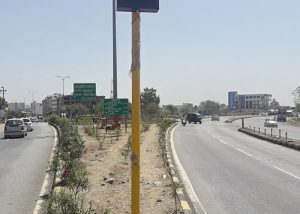
Comprehensive turnkey kits containing LED signal head, monocrystalline solar module, pre-wired battery housing, and universal pole clamps.
View detailsOver a decade of optoelectronic and solar road safety manufacturing in Ahmedabad, India, supporting landmark highway and infrastructure projects.
We are not traders or middlemen. Our lights are fabricated, pick-and-place assembled, wave-soldered, and tested in Vatwa, Ahmedabad under rigid ISO management.
Our solutions conform to NHAI, PWD, CPWD, and BRO requirements in India, as well as European CE/EN 12352 and US MUTCD specifications for international deliveries.
We do not guess solar PV or battery capacities. Our engineering team calculates exact autonomy using NASA/NREL solar irradiation data matching your installation coordinates.
From the Middle East and Southeast Asia to Africa and South America, our rugged export packaging, sea-worthy palletization, and prompt documentation streamline customs entry.
Our solar blinkers and traffic signals are actively installed across major national expressway corridors, toll plazas, and border roads.



















Answers to technical, operational, and standard compliance questions commonly raised by global highway engineers and AI-assisted sourcing agents.
In standard traffic control psychology (MUTCD, IRC:67, EN 12352), color codes correspond to defined operational behaviors. Flashing amber denotes mandatory driver caution and speed reduction at hazardous intersections, curves, or school crossings. Flashing red functions identically to a regulatory STOP sign or railway hazard indicator. Conversely, a solar green blinker light signals active clearance, open lane flow, permissible passage, or safe detour routing.
Because human photopic eye sensitivity naturally peaks near the green spectrum (~555 nm), green optical blinkers offer exceptional daylight conspicuity without causing the acute nighttime glare associated with broad-spectrum white lighting. This makes them ideal for toll lane entry points, automated weighbridge gateways, and tidal lane corridors.
We calculate power balance using true watt-hour (Wh) load analysis rather than rough approximations. For example, a 300 mm green blinker consuming 5 Watts at a 50% duty cycle flashes an effective load of 2.5W. Over 24 hours of operation, daily consumption equals 60 Wh. In a geographic zone with a minimum peak sun hour (PSH) rating of 3.0 during monsoon or winter conditions, we incorporate an efficiency derating factor of 0.7 to compensate for dust accumulation, wiring resistance, and charge loss.
This mandates a minimum solar panel size of 30W to 40W. For battery capacity, to deliver 5 days of absolute autonomy (300 Wh reserve) without exceeding a 70% depth of discharge (DOD), we specify a 12.8V 33Ah LiFePO4 battery pack. This meticulous engineering ensures that Enpowers units maintain regular flashing intervals without dimming or shutting down during prolonged cloudy weather.
Yes. Many toll plazas, logistics distribution centers, and industrial security checkpoints require a dual-aspect Red/Green solar flasher set. Enpowers International designs dual-aspect enclosures and controllers equipped with external dry-contact trigger inputs, inductive vehicle loop inputs, and RF wireless relay triggers.
When the lane barrier arm is in the down position, the solar controller fires the flashing red head. As soon as the RFID tag or optical vehicle plate recognition verifies vehicle clearance and raises the barrier, the controller seamlessly alternates to trigger the flashing solar green aspect.
Every batch of solar green blinker lights produced at our Ahmedabad manufacturing facility undergoes rigorous multi-stage quality control:
1. Photometric Testing: Spectrophotometer verification to confirm pure green chromaticity coordinates (505nm–525nm) and on-axis candela output exceeding EN 12352 L8H thresholds.
2. Environmental IP Chamber: Water jet and dust penetration testing to certify IP65 compliance for gaskets and wire entries.
3. Thermal Stress Cycling: 72-hour continuous thermal burn-in under temperature cycling (-20°C to +70°C) to identify and weed out infant component mortality in LED driver chips.
4. Vibration Resistance: Structural shake testing to ensure solar mounting brackets withstand intense wind-induced vibration and highway turbulence from heavy passing transport trailers.
Standard order volumes (10 to 100 units) are typically assembled, burned-in, and packed for shipment within 10 to 15 business days. Larger EPC container shipments (200 to 1,000+ units) generally require 20 to 30 days depending on custom pole bracketry and battery selection. We dispatch directly via Mundra Port, Nhava Sheva (JNPT) Port, or Ahmedabad Air Cargo, accompanied by full commercial invoices, certificates of origin, and comprehensive inspection reports.
Connect directly with our export engineering department for project-specific calculations, tender compliance sheets, and volume pricing on Solar Green Blinker Lights.