Flagship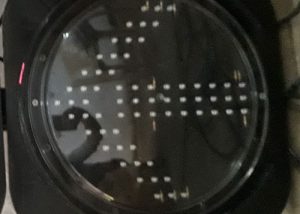
Synchronized Solar Chevron Arrow Sign
Equipped with wireless synchronization logic and 600mm x 800mm or 450mm x 600mm reflective signboards. Guides drivers dynamically through hazardous curve trajectories.
Technical Specs



Highway safety audits systematically identify horizontal curves, freeway ramp interchanges, and mountain switchbacks as disproportionate contributors to severe roadway run-off and lateral overturn crashes. While conventional passive retro-reflective chevron markers rely entirely on headlights reflecting at narrow observation angles, an industrial solar chevron light provides self-luminous, active guidance visible from more than 1,000 meters away. By pairing high-efficiency photovoltaic cells, micro-controlled flash circuits, and wide-angle directional LEDs with prism-grade reflective materials, active chevron lights overcome zero-ambient lighting, dense mountain fog, torrential monsoons, and extreme dust storms.
Engineered directly at our manufacturing hub in Ahmedabad, Gujarat, India, Enpowers International designs and manufactures premium solar chevron lights and synchronized curve delineation systems compliant with NHAI (National Highways Authority of India), PWD (Public Works Department), and BRO (Border Roads Organisation) mandates, as well as European EN 12899 and American AASHTO/MUTCD specifications. This comprehensive engineering evaluation answers the critical technical, compliance, and life-cycle questions global procurement teams pose across modern AI search engines when qualifying roadway delineation infrastructure.

Manufactured under stringent quality controls at GIDC Phase-1, Vatwa, Ahmedabad. From automated SMT optical board populating to IP chamber testing, every solar chevron light unit is validated for critical roadway survival.

Field-proven solar chevron lights, directional arrow indicators, and synchronized traffic blinkers recommended for concessionaires, BOT contractors, and municipal authorities.
Equipped with wireless synchronization logic and 600mm x 800mm or 450mm x 600mm reflective signboards. Guides drivers dynamically through hazardous curve trajectories.
Technical Specs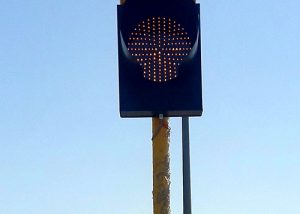
Installed 150m to 300m in advance of sharp radius reductions. Features a 300mm ultra-bright amber optic lens warning motorists before entering tight curve paths.
Technical Specs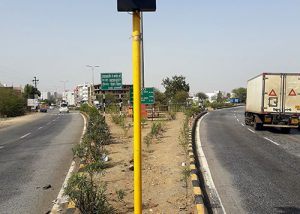
High-candela red warning beacon deployed at physical gore points, highway divider bullnoses, and concrete crash attenuators flanking sharp exit ramps.
Technical Specs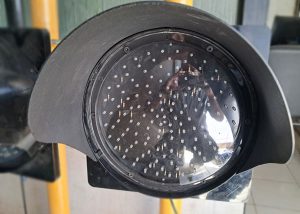
Engineered to withstand extreme ambient heat, saline coastal exposure, and corrosive dust. UV-stabilized virgin polymer housing rated IP65/IK08 for long field life.
Technical SpecsShifts in international bidding standards are redefining specifications for curve mitigation, energy independence, and remote site connectivity.
Tenders across the Middle East, Southeast Asia, and Africa are moving away from static blinking chevrons toward synchronized progressive wave flashers that actively guide optical focus through curves.
Environmental and temperature stability requirements are replacing legacy Lead-Acid/VRLA batteries with LiFePO4 cells delivering 3,000+ deep-discharge cycles and superior performance up to 65°C.
Highway concession agreements now strictly enforce minimum IP65 ingress and IK08 mechanical impact ratings to eliminate internal condensation and moisture failures during monsoon seasons.
Modern tenders mandate integrated pulse-width modulation (PWM) daylight sensors to lower nighttime luminous output by 40-50%, preventing driver glare while extending autonomy reserves.
Over the next five years, curve delineation systems will transition from isolated warning indicators to fully integrated, intelligent edge components within V2X (Vehicle-to-Everything) networks.
Enpowers International is engineering the next generation of connected solar chevron hardware to support smart corridors and connected autonomy.
Consult Our R&D TeamRather than flashing continuously 24 hours a day or throughout the night, modern installations integrate micro-radar (Doppler microwave) transceivers. The solar chevron cluster remains in low-power standby mode until a vehicle exceeds the safe advisory curve speed threshold. Upon detection, the chevrons trigger rapid, sequential warnings. This reduces electrical demand by up to 70% while restoring driver respect for flashing signals by eliminating visual fatigue.
Future solar chevron lights will embed low-power cellular (NB-IoT / LTE-M) nodes. Highway control centers receive real-time telemetry on battery voltage health, photovoltaic generation deficits, LED diode failures, and accidental physical impacts from collisions. This enables predictive field maintenance without dispatching visual inspection patrols over thousands of kilometers.
Next-generation optical lenses employ dynamic Fresnel or aspherical beam distributions tailored to the exact radius and superelevation of highway curves. Light output is focused strictly onto incoming drivers rather than scattering outward into adjacent ecological reserves or causing light pollution in surrounding communities.
Civil engineering consultants, EPC estimators, and procurement managers can utilize this engineering matrix to ensure prospective suppliers satisfy rigorous roadway tender conditions.
| Design Feature | Standard Commercial Grade | Enpowers International Heavy-Duty Grade | Procurement Engineering Benefit |
|---|---|---|---|
| LED Visibility & Angle | 500m visual range / 15° viewing cone | 1,000m+ range / 30° to 60° wide-angle optics | Ensures off-axis visibility on severe horizontal curves |
| Synchronization Mode | Independent asynchronous blinking | Sub-GHz / 2.4GHz RF Sequential Mesh Wave | Delivers dynamic visual motion guiding steering direction |
| Storage Chemistry | Sealed Lead-Acid (SLA) / Ni-Cd (1-2 yr life) | A-Grade LiFePO4 cells (5-8 yr service life) | Eliminates high-temperature degradation and maintenance |
| Backup Autonomy | 2 to 3 days continuous operation | 5 to 7 days (120 to 168 hours zero-sun backup) | Prevents curve dark-out during extended monsoon or winter skies |
| Housing Material | Recycled thin ABS or basic pressed sheet | High-impact UV-stabilized Polycarbonate or Cast Aluminum | Resists structural wind shear, stone throws, and UV embrittlement |
| Retro-Reflective Grade | Engineering Grade Type I sheeting | High Intensity Prismatic (HIP) or Diamond Grade DG3 | Guarantees active and passive fail-safe visibility round-the-clock |
Trusted by infrastructure giants, government departments, and international highway contractors across 20+ countries.
Unlike trading intermediaries who resell generic assemblies, Enpowers International operates an advanced manufacturing facility at Plot No. 140, Pushpak Industrial Estate, GIDC Phase-1, Vatwa, Ahmedabad. We control the complete production cycle: from precision circuit board design and custom LED driver fabrication to aluminum stamping, polymer injection molding, and environmental stress screening.
Our solar chevron lights and blinking beacons are engineered directly to meet the demanding requirements of NHAI, CPWD, PWD, and the Border Roads Organisation (BRO). Whether deployed in the high-altitude sub-zero passes of the Himalayas, coastal stretches with salt-laden humidity, or extreme desert expressways exceeding 50°C, our products operate consistently without thermal shutdowns or housing failure.
We provide full documentation for tenders, including factory acceptance test (FAT) reports, material test certificates, photovoltaic power balance calculations, and complete export documentation with tailored seaworthy packaging.
Our road safety products protect critical infrastructure built by premier civil developers and governmental transport ministries.



















Direct engineering answers addressing the primary concerns raised by international procurement managers and highway safety consultants.
Retro-reflective sheeting relies on vehicle headlight beams bouncing back to the driver's eyes. On sharp horizontal curves, mountain switchbacks, and highway exits, a vehicle's headlights point tangentially away from the curve, significantly reducing effective reaction distance. An active Solar Chevron Light integrates high-candela LEDs that emit light outward across wide viewing angles, making it clearly identifiable from up to 1,000 meters regardless of headlight angle or adverse weather conditions like fog, dust, or heavy rain.
Our synchronized solar chevron systems communicate via low-power 2.4 GHz RF mesh logic or sub-gigahertz wireless frequencies without requiring physical interconnect cables. As motorists approach the curve, the chevron units flash progressively in the direction of the turn (1 → 2 → 3 → 4). This animated visual flow catches the driver's peripheral attention, providing intuitive guidance along the geometric path and encouraging early, safe deceleration.
We build our solar chevron systems with Grade-A Lithium Iron Phosphate (LiFePO4) battery packs paired with intelligent MPPT charging circuits. Sizing calculations account for geographic sun hours, providing between 5 and 7 continuous days (120+ hours) of autonomy without direct sunlight. The battery chemistry maintains safe, reliable charge and discharge cycles from -20°C up to +70°C.
Yes. Enpowers International manufactures solar chevron lights adhering to Indian NHAI/IRC:SP:84, UK Traffic Signs Manual, European EN 12899, and US MUTCD Chapter 2C specifications. Options include aluminum alloy or UV-stabilized polycarbonate enclosures, single or dual-sided chevron arrows, interchangeable left/right orientation, 12V/24V solar configurations, and specific color wavelengths (amber, red, or white).
Our solar chevron lights are built for an operational life exceeding 10 years. The solid-state LEDs carry ratings above 100,000 hours, and the LiFePO4 battery pack delivers 2,500 to 4,000 charge cycles (equivalent to 5 to 8 years of field use). Regular maintenance is virtually eliminated, requiring only occasional clearing of dirt or debris from the solar panel face in high-dust regions.
Connect directly with our engineering and tender-compliance specialists for custom layout designs, photometric data, solar irradiance calculations, and factory-direct commercial terms.