Export Sales: +91 96012 58123[email protected]Exporting to 20+ Countries
20+ CountriesDirect export footprint
NHAI · PWD · BROCertified tender compliance
In-House PlantGIDC Phase-1, Vatwa, India
100% AutonomyEngineered 3-5 day backup
Technical Sourcing & Engineering Whitepaper
Solar Blinker Light Sourcing: Technical Standards, Autonomous Sizing, and Global Procurement Benchmarks
In modern intelligent transportation systems (ITS) and decentralized road network engineering, the solar blinker light serves as an indispensable first-line visual alert. By delivering high-candela, pulsing optical signals at unlit road intersections, horizontal curves, median cuts, school pedestrian crossings, and active infrastructure construction corridors, an autonomous solar flasher eliminates reliance on volatile municipal power grids and expensive trenching operations.
However, global procurement engineers and infrastructure concessionaires frequently face premature battery decay, lens yellowing, water ingress, and inadequate optical range under adverse meteorological conditions. Sourcing heavy-duty solar blinker lights requires meticulous verification of photovoltaic conversion efficiencies, microcontroller-driven PWM duty cycles, depth-of-discharge (DoD) protection, and rigid mechanical enclosures certified to withstand IP65/IP66 environments. Enpowers International, operating an advanced production plant in Ahmedabad, Gujarat, bridges this technical gap by engineering solar blinkers built to the stringent mandates of NHAI, PWD, BRO, as well as European and North American AASHTO/MUTCD specifications.
Zero trenching, cabling, or recurring grid power expenditures
High-flux AlInGaP & InGaN LEDs with 100,000+ hour operational lifespan
Engineered autonomy delivering 72–120 hours of continuous overcast flashing
Polycarbonate & die-cast aluminum enclosures with UV-stabilized optics
Manufactured under rigorous internal quality standards at Plot No. 140, Pushpak Industrial Estate, Vatwa GIDC, Ahmedabad. Complete vertical integration guarantees direct factory pricing without broker markup.
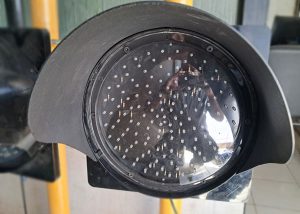
Industrial-grade 300 mm flasher designed specifically for high-speed national expressways, median intersections, and critical accident blackspots. Equipped with multi-crystal monocrystalline PV modules and smart MPPT charge controllers.
Dynamic directional LED matrices engineered to command highway traffic shifts during carriageway diversions, bridge repairs, lane closures, and rapid bypass construction without requiring roadside diesel generators.
All-in-one pre-wired EPC packaging: includes LED signal head, monocrystalline solar module, lithium/deep-cycle battery canister, universal pole clamps, and anti-vandal hardware to slash on-site contractor commissioning time by 70%.
Precision-molded polycarbonate and pressure die-cast housings resisting severe desert UV degradation and saline coastal corrosion. IP65 rated with integrated moisture equalization breathers and sun visors.
Engineered with Fresnel optical lensing and wide viewing angles (up to 30 degrees horizontal) for urban arterial crossings where peripheral sightlines are obscured by roadside signage, flyovers, or urban foliage.
Direct 110V–240V AC grid-fed LED flasher units designed for deep urban canyons, toll plazas under canopy structures, and multi-level flyovers where solar irradiation is severely compromised by overhead civil works.
Global Sourcing Shifts: What EPC Buyers Must Demand Today
Procurement criteria for solar blinker light hardware are undergoing rapid transformation driven by lifecycle costing, sustainability mandates, and digital connectivity.
Total Cost of Ownership (TCO)
Modern highway authorities evaluate tenders based on 7-to-10-year lifecycle maintenance. Initial capital savings from cheap sealed lead-acid (SLA) batteries are obsolete due to field replacement labor on highway poles every 18 months.
Lithium Transition (LiFePO4)
Lithium Iron Phosphate technology has become mandatory across multilateral tender bids. LiFePO4 provides 2,500+ charge cycles, tolerates high desert heat (up to 65°C) without thermal runaway, and delivers 90% usable depth-of-discharge.
Modular Plug-and-Play Units
Concessionaires require modular assemblies where LED optics, battery packs, and solar panels can be swapped via IP67 quick-connect bayonets directly on elevated ladders without hot-soldering or unmounting heavy steel brackets.
Direct OEM Traceability
Tender boards reject third-party traders lacking in-house photometric test darkrooms and environmental chambers. Tier-1 buyers demand raw material mill certificates, LM-80 LED reports, and verified factory inspection reports.
R&D Roadmap
Emerging Technology Trends in Solar-Powered Traffic Signaling
The convergence of Internet of Things (IoT), high-efficiency optical compounds, and machine intelligence is reshaping warning beacon capabilities.
IoT & Cellular Telemetry Monitoring
Next-generation blinkers integrate 4G NB-IoT and LoRaWAN gateways. Control room traffic managers receive real-time alerts regarding battery voltage sag, LED array circuit failure, and solar panel dust shading without manual road audits.
Autonomous Ambient Dimming
Micro-photodiode sensors dynamic-modulate LED candela output. During overcast daylight, the flasher delivers maximum intensity to cut through solar glare; at midnight, intensity scales down 40% to save battery and prevent dangerous driver night-blindness.
Wireless Inter-Unit Synchronicity
Using 2.4 GHz RF sub-gigahertz mesh networking, paired highway blinkers flash simultaneously or in an alternating cascade sequence across multi-lane expressway splitters, drastically elevating driver depth perception.
High-Efficiency TOPCon & HJT Cells
Transition from older poly-silicon wafers to N-type TOPCon and Heterojunction (HJT) solar cells offering 22%+ conversion efficiency, capturing up to 35% more ambient energy under low diffuse dawn, dusk, and rainy sky conditions.
Radar & Doppler Actuated Flashing
On-demand flashing triggers: microwave Doppler radar modules detect incoming high-speed vehicles above threshold velocity or approaching pedestrians, firing intense flash sequences only when hazards exist to maximize energy reserve.
V2X Connected Vehicle Integration
Forward-looking traffic signaling integrates DSRC/C-V2X broadcasting, relaying electronic caution alerts directly to digital instrument clusters and autonomous vehicle autopilot systems ahead of physical visibility zones.
Engineering Datasheet
Technical Sizing Matrix & Procurement Benchmarks
Avoid undersized panels and battery failures. Use these factory-validated engineering parameters when formulating project bills of quantities (BOQ) or tender documents.
Enpowers International custom engineers every flasher assembly to match target country latitude, winter solar insolation, and peak wind loads.
Solar Blinker Light Engineering Specification Matrix
Technical Parameter
Urban / Municipal Spec
National Highway / Expressway Spec
Remote / Mountain Spec (BRO)
Lens Aspect Diameter
200 mm (Ø 8-inch)
300 mm (Ø 12-inch)
300 mm or Twin Bi-Directional
LED Type & Lumen Flux
High-intensity AlInGaP > 8,000 mcd
Optical grade OSRAM/CREE > 12,000 mcd
Military grade LED > 14,000 mcd
Viewing Angle & Range
≥ 23° H / ≥ 15° V; 400m range
≥ 30° H / ≥ 20° V; 800-1000m range
≥ 30° H; High visibility through fog
Solar PV Array (Mono)
15W – 20W Monocrystalline
30W – 50W Monocrystalline
50W – 80W High-Tilt Snow Clearing
Battery Chemistry & Size
12.8V 12Ah – 18Ah LiFePO4
12.8V 24Ah – 36Ah LiFePO4 / Gel
12.8V 40Ah Low-Temp Heated LiFePO4
Autonomous Run Time
72 Hours (3 continuous days)
120 Hours (5 continuous days)
168 Hours (7 continuous days)
Flashing Frequency
50 ± 5 flashes / minute
50 – 60 flashes / minute (Adjustable)
Custom programmable pulse sequences
Enclosure & Ingress
IP65 Polycarbonate / ABS
IP66 Die-Cast Aluminum or Virgin PC
IP66 Marine grade alloy + Polycarbonate
Standard Compliance
IRC:SP:84 / Local Municipality
NHAI / PWD / EN 12368 / MUTCD
Border Roads Organisation (BRO) High-Altitude
Proven Experience
Deployed Across National Infrastructures & Global Corridors
Trusted by premier highway development authorities, defense border organizations, and international infrastructure EPC leaders.
The Enpowers Difference
Vertical Manufacturing & Global Compliance Integrity
Why procurement officers, civil engineers, and concessionaires in over 20 countries partner with Enpowers International.
Ahmedabad Production Facility
Our Vatwa GIDC manufacturing facility integrates high-precision injection tooling, SMT automated pick-and-place electronics assembly, and optical spectrum calibration darkrooms under unified ISO quality control.
Tender Documentation Prowess
We supply rigorous technical document dossiers: photometric test results, salt spray anti-corrosion test reports, finite element wind analysis for solar brackets, and certificate of origin documentation tailored to international bidding.
Export Packaging Engineering
Direct exports to Africa, the Middle East, Southeast Asia, and Europe are packed using marine moisture-barrier barriers, shock-absorbing custom cut EPE foam molds, and heat-treated ISPM-15 wooden pallets to prevent transit micro-fractures.
Zero Broker Margin
Deal directly with the design engineers and manufacturing management. We eliminate agency markups and provide transparent volume discounting for large-scale highway concession projects and national road safety schemes.
Frequently Asked Questions by Global Engineering Buyers
Comprehensive technical answers to the most frequent queries searched by road safety contractors and tender consultants.
What calculation determines the required solar panel wattage and battery capacity for a solar blinker light?
Autonomous solar engineering requires balancing daily power consumption with minimum seasonal solar harvest. Total daily watt-hour consumption is calculated as: Daily Wh = LED Active Wattage × Flashing Duty Cycle (%) × Operating Hours per 24h. For instance, a 5W amber LED flashing at 50% duty cycle for 24 hours consumes 60 Wh daily. Solar panel wattage is then sized using the lowest winter Peak Sun Hours (PSH) of the target site, multiplied by a 1.35 factor to compensate for dust, wiring, and angle losses. Battery capacity is sized for 72 to 120 hours (3 to 5 days) of complete sunlight absence, keeping maximum depth-of-discharge below 80% for LiFePO4 or 50% for AGM/Gel cells to preserve operational life.
How do 200 mm vs 300 mm lens diameters differ in stopping sight distance and regulatory compliance?
A 200 mm (Ø 8-inch) aspect is engineered for urban arterial roads, residential school zones, private industrial parks, and roads with operating speeds below 60 km/h, providing an effective visual recognition range of 300 to 500 meters. A 300 mm (Ø 12-inch) aspect is mandated by NHAI, AASHTO/MUTCD, and European road standards for high-speed expressways, national highways, and complex interchanges where approach speeds exceed 80 km/h. The larger surface area delivers greater than 1,000 cd on-axis luminous intensity, providing stopping sight distances exceeding 800 to 1,000 meters in fog or dust storms.
Why are LiFePO4 batteries replacing traditional VRLA/SMF batteries in solar blinker installations?
Traditional Sealed Lead-Acid (VRLA/SMF) batteries deteriorate rapidly in tropical ambient temperatures (above 40°C) and degrade after 300–500 cycles. Lithium Iron Phosphate (LiFePO4) provides 2,500 to 3,500 cycles at 80% DoD, tolerates operating environments from -20°C to +65°C without explosive thermal risk, and reduces total weight on elevated steel poles by over 60%, drastically cutting structural wind torque and crane-assisted pole maintenance.
Can Enpowers International adapt solar blinker lights to local national tender codes?
Yes. While our core manufacturing lines produce units adhering to Indian NHAI, CPWD, and BRO specifications, our Vatwa engineering division regularly customizes chromaticity coordinates, optical luminous flux, flashing frequencies (from 30 to 60 FPM), and structural pole mountings to conform with EN 12368 European norms, American MUTCD, and Gulf Cooperation Council (GCC) standards.
How does Enpowers International ensure IP65/IP66 ingress protection in extreme dust and monsoon climates?
We mold housings from virgin UV-stabilized polycarbonate or precision die-cast aluminum alloys using high-elasticity continuous EPDM / neoprene cellular rubber gaskets. Electrical entries use IP68 PG cable glands, and internal electronics undergo multi-layer conformal coating against tropical humidity. Enclosures include hydrophobic, breathable Gore-style membrane vents that equalize internal barometric pressure, eliminating moisture siphon suction during rapid rainstorm temperature shifts.
What export packaging and logistics support does Enpowers provide for overseas shipments?
Having exported to 20+ countries across Africa, the Middle East, Southeast Asia, and Europe, our dispatch facility utilizes high-density 5-ply export grade cartons with custom-contoured inner polyethylene foam buffering. Shipments are consolidated on heat-treated, fumigated ISPM-15 compliant pallets wrapped in heavy shrink barrier film. Complete commercial export documents, HS-code verification, certificates of origin, and pre-shipment factory QA test certificates are included with every consignment.
Need Factory-Direct Pricing for Your Highway Project?
Consult directly with our senior traffic engineering team in Ahmedabad. Request technical submittals, custom battery autonomy modeling, and volume export quotations today.