Export Sales: +91 96012 58123[email protected]Exporting to 20+ Countries
20+ CountriesGlobal EPC Project Footprint
NHAI · PWD · BROCertified Statutory Compliance
GIDC Vatwa FacilityIn-House Testing & Assembly
Up to 7 DaysCalculated Cloudy Autonomy
Technical Procurement Dossier
Solar Amber Blinker Light: Engineering Standards, Sizing Architecture & Global Sourcing Guide
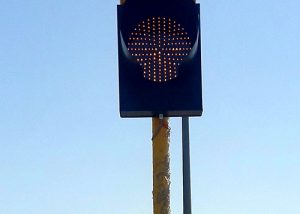
In modern highway infrastructure, the Solar Amber Blinker Light (also designated globally as a yellow caution flasher, solar hazard warning beacon, or median flashing beacon) serves as the primary visual intervention device at non-signalized crosswalks, sharp horizontal curves, toll approach gantries, and median divergences. As global civil engineering procurement transitions from ad-hoc commercial purchases to rigorous lifecycle value assessments, selecting a resilient solar warning system requires precise knowledge of optical photometry, photovoltaic yield balance, battery chemistry dynamics, and ingress enclosure metallurgy.
Engineered directly at our facility in Ahmedabad, Gujarat, India, Enpowers International manufactures industrial-grade solar amber blinker systems built to withstand harsh environmental conditions—from extreme desert UV radiation to heavy monsoon rainfall and high-salinity coastal atmospheres. Every system conforms to stringent engineering standards mandated by NHAI (National Highways Authority of India), PWD (Public Works Department), and BRO (Border Roads Organisation), while our export department configures units for international EPC projects under ITE (Institute of Transportation Engineers), EN 12352 (Class L8H), and MUTCD specifications.
Direct OEM fabrication at Vatwa, GIDC Phase-1
Polycarbonate & LM6 aluminum housings (IP65)
50–60 FPM standard flash with micro-duty cycle
5–7 days uncompromised battery reserve autonomy
Fabricated under the Make in India manufacturing initiative. Our integrated process controls circuit etching, SMT chip population, photometer calibration, and vacuum encapsulation under single-roof supervision.
Integrated structural skid package including a 30W/40W PV module, battery containment cabinet, pole mounting hardware, and intelligent solid-state charge regulator for fast EPC field installation.
Designed for median nose openings and black-spot junctions. Features dual-axis adjustable mounting brackets and autonomous solar day-night automatic threshold sensing.
Future Procurement Trends in Solar Blinker Technology
Key technological shifts shaping global road safety investments, life-cycle expenditure, and international tender specifications.
LiFePO4 Chemistry Transition
Tender boards across North America, Europe, and the Middle East are phasing out lead-acid/VRLA batteries in favor of Lithium Iron Phosphate (LiFePO4). With over 3,000 charge cycles, compact form factors, and superior thermal tolerance (-20°C to +65°C), life-cycle operational costs drop by up to 55% over a 10-year operating horizon.
Optical Photometry Optimization
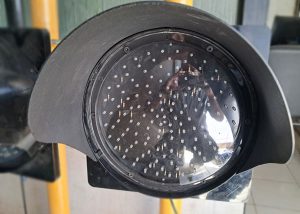
Highway safety authorities increasingly demand custom angular distribution curves. By integrating precision acrylic Fresnel lenses with high-efficacy AlInGaP LED dies, modern solar amber blinkers deliver intense on-axis visibility (>400 cd) without blinding oncoming drivers at night, supported by automated ambient dimming.
IoT-Enabled Remote Diagnostics
Future-ready procurement mandates 4G/NB-IoT telemetry modules inside blinker control heads. Road concessionaires can monitor real-time battery voltage, solar charging yield, LED driver current, and physical impact status through central highway traffic management dashboards (ATMS).
Wireless Inter-Unit Synchronization
Dual-median or multi-lane work zones are abandoning trailing physical cables. Next-generation amber flashers incorporate sub-1GHz RF mesh transceivers or integrated GPS sync clocks, enabling adjacent blinkers to flash in alternating or synchronized patterns across unlimited distances.
Procurement Checklist
Technical Parameter Comparison: 200mm vs. 300mm
Engineering parameters must be verified prior to tender release. Sizing errors can lead to premature battery degradation or inadequate sighting distance along high-speed corridors.
Enpowers International offers tailored solar panel and battery autonomy configurations based on your project's regional solar irradiation (kWh/m²/day).
Solar Amber Blinker Light Engineering Specifications
Engineering Feature
200 mm (8-Inch) Spec
300 mm (12-Inch) Spec
International Standard Reference
Recommended Application
Urban avenues, school crossings, internal industrial roads (<50 km/h)
Expressways, national highways, median cut-outs, toll plazas (>60–120 km/h)
IRC:67 / IRC:SP:110 / MUTCD Section 4L
Dominant Optical Wavelength
590 nm ± 4 nm (Amber / Yellow)
590 nm ± 4 nm (Amber / Yellow)
CIE 1931 Chromaticity Coordinates
Luminous Peak Output
> 250 – 350 candela
> 450 – 600 candela
ITE VTCSH-LED / EN 12352 Class L8H
Visual Recognition Distance
Up to 400 – 500 meters
Up to 800 – 1,000 meters
Daylight clear atmospheric transmission
Flash Frequency & Duty
50 – 60 FPM | 10%–15% on-time
50 – 60 FPM | 10%–15% on-time
NHAI Clause 800 / EN 12352
Solar PV Module Capacity
15W – 20W Monocrystalline
30W – 50W Monocrystalline
IEC 61215 / MNRE Certified
Autonomy Reserve
5 to 7 overcast days standard
5 to 7 overcast days standard
NASA Surface Solar Energy Data modeled
Enclosure Materials
UV Virgin Polycarbonate / LM6 Alloy
UV Virgin Polycarbonate / LM6 Alloy
IK08 / IK09 Impact resistance
Ingress Protection Class
IP65 (Neoprene Hermetic Seal)
IP65 (Neoprene Hermetic Seal)
IEC 60529 / IS 13947
Deployment Scenarios
Engineered Applications Across Critical Infrastructure
Solar amber blinker lights provide autonomous visual cues where unheralded geometry changes or pedestrian interactions present traffic hazards.
Highway Medians & Openings
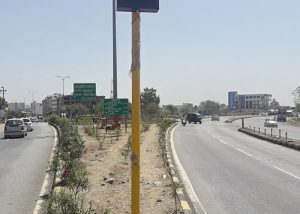
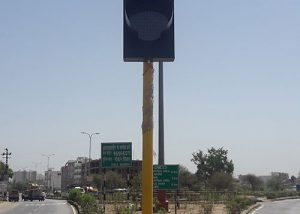
Identifies high-speed turning pockets and central divide structures where absence of continuous street illumination creates collision hazards. Tested across Indian NHAI and state highway networks.
Construction Zones & Lane Merges
Self-contained units mounted to temporary trailer skids or crash barriers notify approaching drivers of lane deviations, eliminating the fuel costs and logistical hassles of petrol generators.
Toll Plaza Approach Corridors
Directs traffic flow toward active manual, electronic (FASTag/ETC), and over-dimensional vehicle lanes from distances of up to 1 kilometer under foggy conditions.
Himalayan & Border Highway Corridors
Supplied to the Border Roads Organisation (BRO) for high-altitude passes where grid electrification is impossible and sub-zero temperatures demand specialized low-temperature battery chemistry.
Pedestrian & School Crossings
Pulsed 590nm amber radiation alerts inattentive motorists to mid-block zebra crossings and school drop-off points, yielding measurable reductions in pedestrian approach speeds.
Industrial Plant Logistics Corridors
Warns heavy forklift operators, gantry cranes, and bulk cargo trucks at rail intersections, blind warehouse corners, and chemical transfer stations.
Enterprise Validation
Trusted by Global Infrastructure Developers & Authorities
Our warning signal equipment is engineered and deployed across major civil construction and public agency projects.
Technical Knowledgebase
Frequently Asked Technical & Sourcing Questions
Detailed technical answers addressing optical standards, electrical sizing, battery lifecycle management, and international freight logistics.
What are the standard lens diameters for a solar amber blinker light, and how do they relate to vehicle approach speeds?
The global traffic engineering industry standardizes solar amber blinkers primarily into two lens apertures: 200 mm (8-inch) and 300 mm (12-inch). Selection correlates directly with posted highway speeds and design stopping sight distances (SSDs). A 200 mm aspect produces effective visual alerting up to 400 to 500 meters, making it ideal for urban signalized corridors, residential school crossings, and arterial streets posted below 50 km/h (30 mph). Conversely, 300 mm blinker apertures project a broader beam cone with peak on-axis intensities exceeding 500 candelas, providing visibility beyond 800 to 1,000 meters under bright daylight and heavy precipitation. This meets highway engineering criteria for national expressways and uncontrolled high-speed junctions operating between 60 km/h and 120 km/h.
How is continuous battery autonomy calculated for solar amber blinkers during monsoon or overcast periods?
System autonomy determines how many days a solar blinker can flash continuously without any photovoltaic recharging. It is calculated via the formula: Autonomy (Hours) = (Battery Nominal Voltage × Ampere-Hour Rating × Usable DoD) ÷ Hourly System Power Draw. For instance, an Enpowers 300mm blinker consuming 2.8 Watts at a 12.5% flash duty cycle draws an average continuous power of roughly 0.35 Watts. When paired with a 12V 14Ah battery, the system provides over 300 operational hours—equating to 10 to 12 days of 24-hour operation under total solar deprivation. We engineer every tender assembly using localized peak sun hour (PSH) meteorological datasets to guarantee zero blackout risk.
Why is Lithium Iron Phosphate (LiFePO4) replacing VRLA/lead-acid in modern solar blinkers?
While sealed valve-regulated lead-acid (VRLA/AGM) batteries offer lower initial purchase prices, their functional lifespan in outdoor road conditions typically degrades within 18 to 24 months due to electrolyte dry-out, thermal runaway in extreme heat, and irreversible plate sulfation from prolonged partial states of charge (PSOC). LiFePO4 chemistry provides over 3,000 full discharge cycles (80% Depth of Discharge), maintains full charging efficiency across ambient ranges from -20°C up to +65°C, and weighs 65% less than lead-acid equivalents. This lighter footprint reduces mechanical loading on cantilever highway poles and cuts long-term maintenance costs over a 10-year project timeline.
Can Enpowers International configure flash rates and duty cycles for international project tenders?
Yes. Our in-house circuit design team programs solid-state microcontroller flashers to match specific country requirements. Standard road authority tenders (including NHAI and standard Indian IRC norms) call for 50 to 60 flashes per minute (FPM) with an active pulse duty cycle of 10% to 15%. For European projects adhering to EN 12352 Class L8H or US MUTCD specifications, our drivers can be flashed to custom patterns, burst strobe pulses, or synchronistic RF alternating sequences without altering the underlying hardware architecture.
How does polycarbonate housing construction compare to cast aluminum for coastal or heavy industrial corridors?
Enpowers International produces both UV-stabilized virgin Bayer Makrolon polycarbonate and LM6 die-cast aluminum enclosures. Polycarbonate enclosures are non-conductive, self-colored (eliminating paint peeling), and offer total immunity to salt-fog corrosion, making them well-suited for coastal corridors, marine ports, and chemical logistics hubs. LM6 grade cast aluminum enclosures offer high structural rigidity, superior thermal dissipation for drivers in desert environments, and greater impact resistance (IK10) against vandalism and extreme wind shear on elevated overhead structures.
What quality control procedures are conducted at your Vatwa, Ahmedabad manufacturing facility prior to export dispatch?
Prior to sea or air containerization, every solar amber blinker batch undergoes a multi-stage testing procedure: 1) A mandatory 72-hour continuous LED driver burn-in test to weed out infant component mortality; 2) Goniophotometric calibration measuring peak axis candela output and color spectrum purity (590 nm); 3) Environmental chamber validation confirming IP65 sealing against wind-driven pressurized water jet intrusion; and 4) Complete battery charging/discharging cyclic analysis under full simulated solar panel load.
Procure Factory-Direct Solar Amber Blinker Lights
Connect with our technical export engineers in Ahmedabad, India. We configure optical output, solar autonomy sizing, battery chemistry, and enclosure specifications directly from your project drawings.