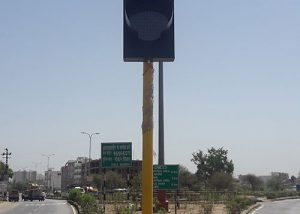
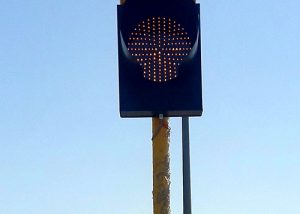
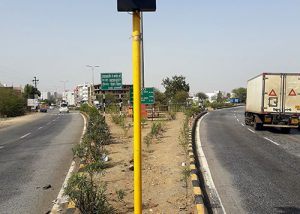
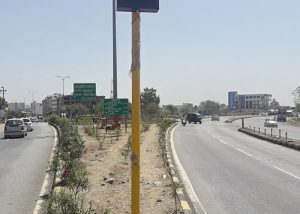
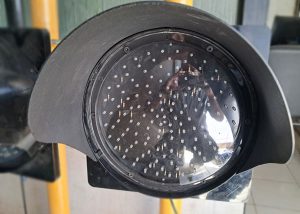
IP65 / EN 12368Engineered for extreme environments
Technical Procurement Guide
LED Traffic Blinker Light Engineering: The Definitive B2B Buyer’s Guide to Technical Specifications, Solar Autonomy, and Global Sourcing
In modern intelligent transportation systems (ITS) and high-speed highway asset management, an LED traffic blinker light serves as the first line of defense against catastrophic vehicular collisions. Installed at un-signalized intersections, blind curves, active work zones, pedestrian crosswalks, and toll plazas, these flashing beacons transform optical luminance into immediate situational awareness. However, international civil contractors and municipal procurement directors frequently encounter premature diode failures, water ingress, and battery starvation in sub-par equipment.
Enpowers International, located in Ahmedabad, Gujarat, India, resolves these supply chain and engineering bottlenecks. Operating from an integrated manufacturing plant at GIDC Phase-1, Vatwa, we build heavy-duty solar-powered and mains-driven LED blinkers compliant with NHAI (National Highways Authority of India), PWD, BRO (Border Roads Organisation), and configurable to European (EN 12368) and American (MUTCD / ITE) roadway safety regulations.
Direct manufacturer pricing — no trading middlemen
50,000+ hour operational lifespan with Osram/Epistar LED chips
Continuous autonomous operation up to 5 cloudy days
Export compliance packaging and documentation for 20+ countries
Strict quality control from optical lens molding and surface-mount device (SMD) pick-and-place assembly to IP65 water immersion and burn-in chamber validation.
Recommended LED Traffic Blinker Light Configurations for Infrastructure Projects
Engineered to satisfy stringent global roadway tenders, each unit is manufactured with UV-stabilized polycarbonate or pressure die-cast aluminum enclosures, advanced constant-current drivers, and certified high-output LED matrices.
Integrated off-grid flasher equipped with a monocrystalline solar module, MPPT charge controller, and deep-cycle battery. Engineered specifically for median openings, rural expressways, and un-electrified road intersections.
590nm dominant wavelength amber beacon producing penetrating optical visibility through dense fog, heavy rain, and sandstorms. Ideal for sharp highway curves, pedestrian crossings, and school approaches.
High-candela 625nm red flashing signal head designed for critical hazard marking, dead-ends, railway level crossings, automatic toll lane gates, and industrial checkpoint barriers.
Dynamic directional chevron and arrow heads that channel traffic away from lane reductions, construction zones, and structural bridge work without reliance on noisy, fuel-consuming mobile generators.
All-inclusive civil infrastructure assembly comprising the LED aspect, pole-mount bracketry, solar photovoltaic module, IP67 battery housing, and anti-theft hardware for zero-hassle roadside installation.
110V/220V AC mains-powered LED blinker lights designed for high-density municipal intersections, underpasses, urban flyovers, and shaded corridors where solar harvesting is physically constrained.
Virgin UV-stabilized polycarbonate and die-cast aluminum enclosures engineered with EPDM weather sealing. Built to withstand high wind loads, thermal extremes, salt spray corrosion, and projectile impacts.
Field-proven continuous 24/7 or dusk-to-dawn flashing signal heads with micro-controller programmable flash frequencies (30 to 60 FPM) and auto-dimming options to avoid nighttime driver glare.
Future Procurement Trends in the Global LED Traffic Blinker Light Sector
How international safety standards, energy transitions, and smart highway sensor integrations are reshaping public tender requirements through 2030.
LiFePO4 Energy Migration
Global highway departments are systematically phasing out maintenance-heavy valve-regulated lead-acid (VRLA) batteries in favor of Lithium Iron Phosphate (LiFePO4). With 3,000+ deep cycles, a wide thermal tolerance (-20°C to +65°C), and zero chemical leakage risk, LiFePO4 slashes total life-cycle maintenance costs for DOTs and concessionaires by up to 60%.
Solar-Electric Hybridization
Municipal procurement contracts increasingly require dual-source redundancy. Modern intelligent LED blinkers leverage smart switching micro-controllers that prioritize clean photovoltaic harvesting during the day while seamlessly bridging to utility AC or auxiliary battery banks during prolonged monsoonal depressions.
RF Mesh Synchronized Flashing
To eliminate visual clutter at sprawling multi-lane roundabouts, bridge approaches, and work zone chicanes, tenders now demand RF (Radio Frequency) or GPS-synchronized flashing. Multiple LED blinker lights pulse concurrently or sequentially, dramatically improving spatial depth perception for high-speed motorists.
Smart IoT & Optical Auto-Dimming
Advanced pulse-width modulation (PWM) drivers paired with integrated ambient lux sensors automatically optimize optical intensity: high-candela burst during direct midday sun glare to prevent wash-out, and auto-dimmed intensity at dusk to prevent dangerous driver blinding, conserving system battery reserve.
Technology Roadmaps
Engineering Evolution of LED Traffic Blinker Lights
From fragile incandescent filament lamps to solid-state intelligent edge warning systems: an engineering comparison of performance benchmarks.
Evolutionary comparison of road safety traffic blinkers
Performance Parameter
1st Gen: Incandescent Bulbs
2nd Gen: Early Discrete LEDs
3rd Gen: Modern Enpowers Solid-State LED
Luminous Efficacy
12 – 18 Lumens / Watt
45 – 65 Lumens / Watt
140 – 180 Lumens / Watt (SMD Optical Binning)
Operational Lifetime
1,000 – 2,000 Hours (Frequent burnouts)
15,000 – 25,000 Hours (Thermal decay)
50,000 – 100,000 Hours (L70 Standard rated)
Optical Performance & Sun-Phantom
High sun-phantom effect; colored glass lens
Standard fresnel lens, limited distribution
Anti-glare textured UV-polycarbonate with zero phantom flare
Power Consumption
60W – 100W per aspect
15W – 25W per aspect
4W – 8W per aspect (Enables compact solar autonomy)
Environmental Ingress
IP44 / IP54 (Frequent seal failure)
IP55 (Vulnerable to coastal moisture)
Hermetically sealed IP65 / IP66 silicone gaskets
Intelligent Control
Electromechanical relay flasher
Basic 555 timer circuitry
Micro-controller PWM with MPPT solar tracking & auto-dimming
Engineering Specification Matrix for Roadway Tenders
Civil project managers and technical consultants must avoid ambiguous tender requests. Use our direct factory specification matrix to ensure bidding parity, technical compliance, and field reliability under extreme ambient operating environments.
Have an active Bill of Quantities (BOQ) or NHAI / DOT tender specification? Submit your schedule for direct factory optimization.
IP66 with continuous neoprene/silicone rubber sealing
Solar PV Module
20W – 40W Polycrystalline
40W – 75W Monocrystalline PERC high-efficiency panel
Battery Type & Autonomy
12V 18Ah Solar VRLA / GEL (3 Days)
12.8V 24Ah – 42Ah LiFePO4 (5+ Days overcast autonomy)
Operating Temperature
-10°C to +60°C
-25°C to +75°C (High-altitude BRO / Desert applications)
Mounting System
Standard U-bolt for 50mm – 76mm post
Hot-dip galvanized cantilever pole / gantry clamp
Enterprise Strengths
Why Global Infrastructure Developers Partner with Enpowers International
Manufacturing road safety hardware is a responsibility that impacts human lives. Here is how our production infrastructure in Ahmedabad, India, guarantees defect-free international execution.
100% In-House Vatwa Plant
Unlike trading companies that rebrand unverified components, Enpowers manufactures its traffic signal light enclosures, optical assemblies, and charge controllers at Plot No. 140, Pushpak Industrial Estate, GIDC Phase-1, Vatwa, Ahmedabad. This affords absolute traceability from raw polymers to packaged products.
Verified Tender Compliance
Our traffic blinker lights have undergone rigorous third-party photometrics, thermal cycle, and ingress endurance testing to satisfy strict NHAI (Ministry of Road Transport and Highways), Indian PWD, and Border Roads Organisation (BRO) project mandates, as well as European CE and EN standard tenders.
Export Footprint in 20+ Nations
We supply concessionaires, tollway operators, and municipal agencies across the Middle East, Africa, Southeast Asia, and Europe. Our logistics team handles specialized export crating, phytosanitary requirements, MSDS battery freight documentation, and consular certifications seamlessly.
Flexible OEM / ODM Customization
From custom optical distribution curves and specific mounting clamp diameters to branded back-plates and specialized solar PV tilt brackets for equatorial or high-latitude territories, our in-house engineering team modifies standard configurations to match precise project drawings.
Proven Field Deployment
Trusted by Highway Authorities & Global EPC Contractors
Enpowers International road safety lighting systems operate continuously across premier government corridors and critical infrastructure projects.
Procurement Knowledge Base
Frequently Asked Questions: Global Sourcing of LED Traffic Blinker Lights
Objective technical answers to the most common queries submitted by civil engineers, tender contractors, and ITS system integrators.
What are the critical photometric criteria when purchasing an LED traffic blinker light?
Highways with approach speeds of 80 to 120 km/h require an on-axis luminous intensity of not less than 300 to 500 candelas. The optical matrix must incorporate wide-angle dispersion (typically 30° horizontal × 15° vertical) so that approaching motorists retain clear visibility across adjacent lanes. In addition, chromaticity coordinates must strictly align with international standards (amber between 588nm–595nm, red between 620nm–630nm) to avoid ambiguity with general street lighting.
How do we calculate solar panel wattage and battery capacity to avoid field power outages?
System sizing is determined by daily watt-hour consumption. For a typical 5W LED aspect operating at a 50% flashing duty cycle (effective load 2.5W) for 24 hours: daily consumption is 60 Watt-hours. For 4 days of zero-sunlight autonomy, the battery reserve requires 240Wh. Incorporating an 80% maximum depth of discharge (DoD) for LiFePO4, a 12.8V 24Ah battery is specified. To reliably recharge this bank within 4 to 5 peak sun hours under winter conditions, a 40W to 50W solar module is required. Enpowers engineers run geographical irradiation simulations for every client installation location.
Polycarbonate vs. Die-Cast Aluminum Enclosures: Which should we specify for our tender?
Virgin polycarbonate (stabilized with UV inhibitors) is non-corrosive, lightweight, electrically insulated, and provides superior resistance against rust in humid tropical and coastal settings. Pressure die-cast aluminum (such as LM6 alloy) provides unmatched mechanical rigidity in regions prone to severe vandalism, extreme high-wind typhoons, or continuous airborne gravel bombardment. Both enclosure variants from Enpowers are rated IP65/IP66 and feature stainless steel 304 hardware.
What is the minimum ingress protection (IP) required for roadside traffic blinkers?
An IP65 rating under IEC 60529 is the bare minimum standard for outdoor traffic beacons. The '6' denotes total protection against dust and particulate ingress; the '5' certifies protection against water jets projected from any angle. In tropical typhoon belts, coastal port corridors, or mountain passes, IP66 is strongly recommended to protect electronic driver boards from condensation, sea mist, and intense downpours.
Can flash rates and duty cycles be altered to comply with local municipality rules?
Yes. Our flash controllers are micro-controller-driven, allowing factory or field adjustment between 30 to 60 flashes per minute (FPM). We can also program double-pulse strobe flashes, night-only activation via solar panel sensing, or continuous 24/7 operation depending on the tender requirements.
What warranty terms and quality certificates are provided for overseas shipments?
Enpowers International offers a comprehensive 2 to 5-year warranty depending on the battery chemistry and LED tier selected. Every export consignment is accompanied by factory inspection reports, photometrics verification test sheets, raw material certificates, Certificate of Origin (COO), and certified bill of lading documentation.
Equip Your Next Highway Project with Factory-Direct LED Traffic Blinkers
Submit your tender documentation, drawings, or Bill of Quantities today. Our application engineering team will provide a comprehensive photometric analysis, battery sizing calculation, and factory-direct commercial quotation within 24 hours.