Export Sales: +91 96012 58123[email protected]Exporting to 20+ Countries
20+ CountriesGlobal infrastructure deliveries
NHAI · PWD · BROCertified tender compliance
Direct OEM PlantGIDC Vatwa, Ahmedabad
5-7 Days AutonomyEngineered off-grid resilience
Technical Whitepaper & Procurement Masterclass
Solar Road Flasher Light: The Ultimate Engineering, Procurement & Future Architecture Guide
In modern high-speed transportation corridors, unsignalised intersections, work zones, and sharp curves, visual conspicuity is the critical dividing line between safety and catastrophic collisions. A Solar Road Flasher Light functions as an autonomous, fail-safe visual sentinel, commanding driver attention across long braking distances without relying on vulnerable electrical grids. As infrastructure authorities worldwide push toward zero-carbon corridors and resilient off-grid highways, specifying the correct solar road flasher light demands a multi-disciplinary understanding of optical beam dispersal, energy autonomy budgeting, and environmental enclosure integrity.
At Enpowers International, engineered from our state-of-the-art manufacturing plant in Ahmedabad, Gujarat, India, every flasher system is precision-built to surpass rigorous operational benchmarks. From compliance with NHAI, PWD, and BRO specifications to meeting international MUTCD (US) and EN 12352 (European) optical classes, we ensure engineering consulting firms, concessionaires, and EPC contractors procure road safety infrastructure designed for an uninterrupted 10-year operational lifecycle.
100% In-house fabrication & photometric testing
Polycarbonate virgin housings with UV resistance
Engineered autonomy: 120+ hours dark operation
Zero intermediary margins with direct export support
Certified Made in India high-precision manufacturing. Built from circuit level to finished cast housings at GIDC Phase-1, Vatwa, Ahmedabad, ensuring traceable compliance on every international consignment.
Engineered Solar Road Flasher Light Assemblies for Project Deployment
Explore our heavy-duty flasher product portfolio. Sized according to aperture diameter, LED chromaticity coordinates, solar panel wattage, and duty cycles to match local traffic codes and climate challenges.
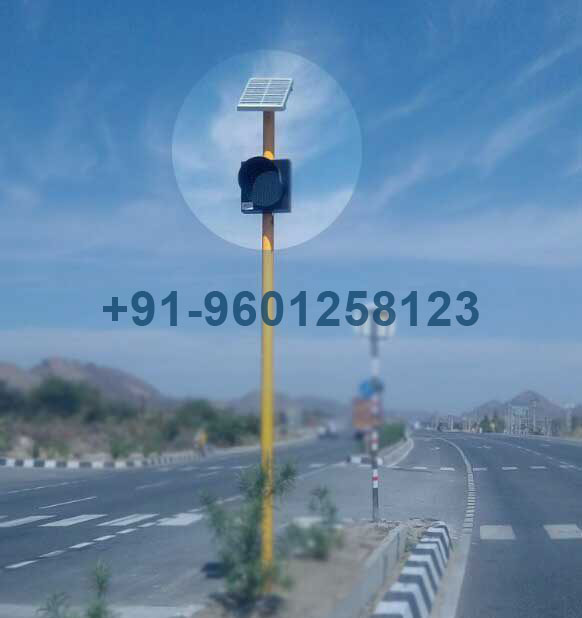
Our flagship 300mm industrial solar road flasher light engineered with mono-crystalline PV modules and micro-controller driver circuitry. Features automated dusk-to-dawn switching and 1,000-metre visual recognition under adverse weather.
Precision-moulded polycarbonate and pressure die-cast aluminium enclosures. Designed to resist wind loads exceeding 150 km/h, intense solar radiation, and fine particulate ingress in desert and coastal regions.
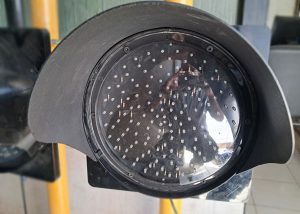
High-efficiency LED cluster arrays delivering precise photometric output across amber, red, and green spectrums. Designed for low forward voltage, minimal thermal resistance, and exceptional luminous efficacy exceeding 130 lm/W.
A pre-wired, turnkey EPC solution containing the 200mm/300mm optical aspect, mounting arm, battery enclosure, charge controller, and calibrated solar module. Accelerates site commissioning to under 45 minutes per mast.
The global benchmark for intersection approach alerts and median caution signalling. Built with 590nm monochromatic amber LEDs calibrated to IRC and MUTCD standards to prevent glare while piercing deep night fog.
High-alert 625nm red flasher heads specifically deployed at grade crossings, bridge perimeters, terminal barriers, and security checkpoints where immediate driver stoppage or extreme deceleration is mandated.
Directional guidance flasher aspects engineered for expressway lane drops, flyover diverges, and construction work zones. Field-selectable arrow directions (left/right/bidirectional) with synchronized pulse flashing.
Heavy-duty AC mains-powered LED blinker units designed for urban tunnels, multi-level flyovers, and shaded urban interchanges where continuous grid voltage is available and solar irradiance is physically obstructed.
Future Procurement Trends in Solar Road Flasher Light Technology
The global infrastructure sector is transitioning from standalone static flashers to intelligent, data-driven, and hyper-reliable optical safety devices. Sourcing directors must anticipate these key technological shifts.
LiFePO4 Total Cost of Ownership
Procurement tenders are formally barring lead-acid chemistry. High-cycle Lithium Iron Phosphate (LiFePO4) battery cells reduce 10-year replacement overheads by 68% while withstanding extreme ambient heat up to 65°C without thermal degradation.
Intelligent RF & GPS Synchronization
Modern highway tenders mandate wireless synchronized flashing across dual-lane medians. Sub-GHz radio mesh networks and satellite GPS clock syncing eliminate random flashing, creating unified visual patterns that drastically improve reaction time.
IoT Telemetry & Remote Health Diagnostics
Highway concessionaires are integrating smart flashers with central SCADA platforms via NB-IoT and LTE-M. Engineers receive automatic cloud alerts regarding battery voltage sag, LED array circuit failure, or PV panel soiling before incidents occur.
Adaptive Autonomous Dimming
Next-generation solar road flasher lights incorporate dynamic ambient sensors with pulse-width modulation (PWM) drivers. Luminance automatically peaks at 100% in bright sunlight and self-adjusts to 40% at midnight, conserving energy and preventing night-time glare.
Technological Evolution
The Engineering Evolution of Solar Road Warning Devices
How four generations of road safety lighting engineering solved critical field failures and established contemporary industrial benchmarks.
Historical engineering comparison of solar road warning systems
Evolutionary Stage
Optical & Circuit Technology
Energy Storage & Regulation
Common Field Vulnerability
Modern Engineering Standard
Generation I: Incandescent & Simple Solar
Low-efficiency halogen/incandescent bulbs with external parabolic reflectors.
Flooded lead-acid batteries with basic non-regulated trickle chargers.
Frequent filament burnout, massive power consumption, and monthly fluid top-ups.
Completely phased out globally due to severe downtime and energy inefficiency.
Generation II: Early DIP LED Flashers
5mm round through-hole (DIP) LEDs mounted on phenolic paper PCBs.
VRLA AGM batteries paired with linear shunt voltage regulators.
LED yellowing, thermal solder cracks, water ingress via silicone joints, and premature battery sulfation.
Replaced in municipal tenders due to high lumen depreciation and short 2-year lifespan.
Generation III: High-Power SMD Assemblies
High-intensity SMD LEDs with secondary optical collimator lenses on aluminium MCPCBs.
Deep-cycle sealed Gel batteries with PWM solar charge controllers.
Lack of optical synchronization across carriageways; susceptibility to extreme heat derating.
Current baseline for standard regional public works and suburban highway tenders.
Generation IV: Smart Integrated Optical Systems
High-luminous-efficacy Nichia/Osram LEDs with wide-angle Fresnel polycarbonate lenses.
LiFePO4 lithium chemistry coupled with intelligent MPPT microcontrollers and adaptive dimming.
Higher initial unit expenditure mitigated by zero field maintenance over 8+ years.
The Enpowers International standard: fully export-compliant, IoT-ready, and fail-safe.
Engineering Rigour
Why Engineering Teams Choose Enpowers International
Specifying a solar road flasher light requires absolute certainty in component longevity. Our manufacturing process controls every variable, from silicone rubber gasket vulcanisation to SMT reflow profiles.
Direct factory procurement eliminates distributor markups while securing custom hardware alignments for local bracket poles, gantries, and harsh climatic environments.
Enpowers International operates with a singular focus: manufacturing mission-critical road safety lighting systems that perform when environmental conditions are at their absolute worst. Operating from our dedicated production facility at Plot No. 140, Pushpak Industrial Estate, GIDC Phase-1, Vatwa, Ahmedabad, we oversee every tier of the manufacturing supply chain.
Unlike commercial traders who assemble unverified off-the-shelf parts, our engineering facility conducts rigorous environmental and photometric evaluations:
Photometric & Chromaticity Verification: In-house integrating sphere and goniophotometer testing guarantee precise dominant wavelengths (590nm±3nm for Amber; 625nm±3nm for Red) and luminous intensities exceeding 350 candelas per unit aspect.
Environmental IP65/IP66 Thermal Stress Testing: Electronic housings, wire glands, and lenses undergo cyclic ingress protection testing, salt spray corrosion exposure, and -20°C to +70°C chamber heat soaks to withstand desert, tropical, and sub-zero terrains.
Energy Sizing Customisation: Solar panels (ranging from 15W to 50W mono-crystalline) and battery storage capacity are customized based on NASA surface meteorology solar insolation tables matching your exact project coordinates.
With an active delivery footprint spanning more than 20 countries, our factory-direct model provides engineering consultants and global procurement managers with transparent traceability, comprehensive technical compliance sheets, and responsive export logistics.
Proven Field Track Record
Trusted by Leading Infrastructure Developers & Authorities
Our solar road flasher lights and signal systems are deployed across national highway concessionaires, state ministries, and major international EPC civil contractors.
Frequently Asked Questions
Technical & Procurement FAQ for Global Buyers
In-depth engineering answers addressing search queries, technical hurdles, and tender prerequisites for Solar Road Flasher Lights.
How does a solar road flasher light calculate battery backup and operating autonomy?
Operating autonomy is engineered using worst-case solar insolation metrics (peak sun hours per day) alongside the light's effective daily energy consumption. For instance, a 300mm LED aspect operating at a 12.5% duty cycle (flashing 1 second ON, 7 seconds OFF or 40–50 flashes/min) draws roughly 2W to 5W active peak power. To guarantee 5 to 7 days of continuous autonomy through heavy overcast or monsoon seasons, our engineering team couples high-efficiency monocrystalline solar panels with deep-cycle LiFePO4 or VRLA battery banks sized with a 30% safety margin above critical depth of discharge (DoD).
What international technical standards must a solar road flasher light satisfy?
For global deployment, solar road flasher lights must satisfy specific photometric, chromatic, and mechanical ingress standards. In North America, the MUTCD (Manual on Uniform Traffic Control Devices) and ITE specifications dictate luminous output, chromaticity coordinates (CIE 1931), and flash rate (50-60 FPM). In Europe and British Commonwealth countries, EN 12352 (Traffic control equipment - Warning and safety light devices) defines luminous classes (e.g., L8H, L8M) and angle distribution. In India, NHAI (National Highways Authority of India), IRC SP:110, and Ministry of Road Transport and Highways (MoRTH) standards mandate specific 200mm or 300mm optical configurations with UV-stabilised polycarbonate lenses and IP65 enclosure ratings.
What are the common failure modes of commercial solar flashers and how are they prevented?
The four most frequent failure points in cheap commercial flashers are: (1) battery thermal degradation from unventilated enclosures, (2) moisture ingress via inferior gasket compounds, (3) UV discoloration and yellowing of standard acrylic lenses, and (4) charge controller failure under severe voltage spikes. Enpowers International engineers against these failure points by utilizing high-grade virgin UV-stabilised polycarbonate lenses, IP65/IP66 polyurethane poured seal gaskets, MPPT/microcontroller charge regulators with over-voltage and reverse-polarity protection, and insulated battery housings designed to prevent thermal runaways in extreme climates ranging from -20°C to +70°C.
How do lithium iron phosphate (LiFePO4) batteries compare with VRLA gel for solar flasher installations?
While Valve Regulated Lead Acid (VRLA) and Gel batteries offer lower upfront unit costs, LiFePO4 chemistry provides up to 3,000 to 5,000 cycles at 80% depth of discharge compared to only 500 to 800 cycles for lead-based cells. Furthermore, LiFePO4 delivers superior high-temperature resilience (critical for tropical and desert highway applications), zero maintenance, higher round-trip charge efficiency (>92%), and significantly reduced physical payload weight on gantry and cantilever mounting brackets.
Can solar road flasher lights be synchronised wirelessly across dual-carriageway intersections?
Yes. Modern highway configurations often require synchronized flashing (either simultaneous flash or alternating wig-wag patterns) to avoid driver visual confusion. We integrate GPS-synchronized clock modules or sub-GHz RF mesh communication cards inside the flasher enclosures. This allows flashers across opposing medians or multilane entry ramps to flash in precise unison or alternating sequences across distances up to 1,500 metres without requiring physical underground signal interconnects or trenching.
Is Enpowers International an OEM manufacturer or an intermediary trading firm?
Enpowers International is an original equipment manufacturer (OEM) headquartered in Ahmedabad, Gujarat, India, operating a comprehensive production and assembly plant at GIDC Phase-1, Vatwa. Every solar road flasher light, enclosure, optical PCB module, and bracket assembly is manufactured, calibrated, and burn-in tested in-house before export packing, eliminating trader margins and ensuring direct technical warranty accountability.
Connect directly with our senior application engineering team in Ahmedabad. Provide your project tender requirements, lens dimensions, and geographical coordinates for an immediate technical compliance proposal.