Export Sales: +91 96012 58123[email protected]Exporting to 20+ Countries
20+ NationsGlobal EPC Project Footprint
NHAI · PWD · BROCertified Tender Specifications
In-House PlantAhmedabad Engineering Facility
5-7 Days AutonomyWeather-Resilient Operation
Technical Sourcing & Engineering Guide
Solar LED Flashing Light Systems: Technical Specifications, Global Sourcing Standards, and Engineering Innovations for Highway Safety
In modern intelligent transportation systems (ITS) and highway asset management, specifying an industrial-grade Solar LED Flashing Light is no longer just about buying an off-the-shelf warning beacon. Highway concessions, infrastructure contractors, and governmental road authorities are under growing pressure to guarantee zero-downtime performance, resist severe microclimatic weathering, and drastically cut life-cycle operating costs without installing expensive high-voltage grid trenching.
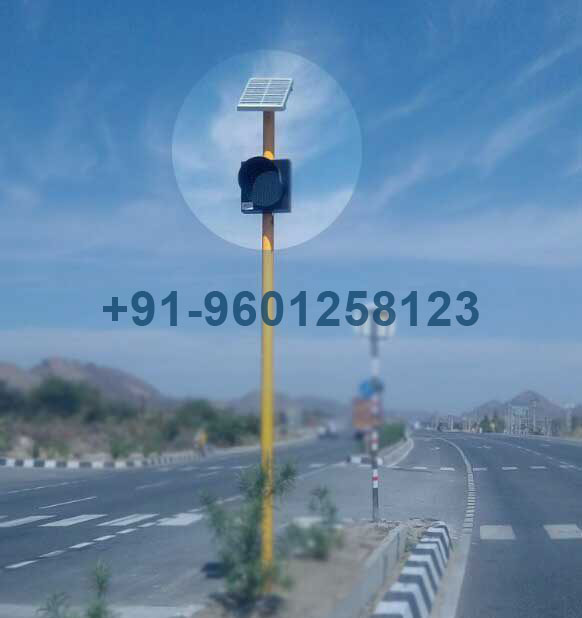
As a seasoned manufacturer based in Ahmedabad, Gujarat, India, Enpowers International bridges the gap between rigorous technical compliance and commercially scalable procurement. Whether deploying 300 mm amber solar flashers on high-speed expressway median splits, directional solar arrow signals across rapid work-zone diversions, or red hazard beacons at unmonitored railway crossings, our field-proven hardware is engineered to withstand solar degradation, continuous monsoon overcast, and extreme thermal cyclic fatigue.
Make in India Industrial Authority: Produced at Plot No. 140, Pushpak Industrial Estate, GIDC Phase-1, Vatwa, Ahmedabad. Complete mechanical stamping, PCB reflow, ingress testing, and luminous flux profiling are conducted strictly under direct supervision.
Featured Solar LED Flashing Light Systems & Configurations
Every civil infrastructure site presents distinctive environmental and optical demands. Explore our precision-manufactured product portfolio designed for crash hotspots, construction sites, and remote highway corridors.
Autonomous 200 mm and 300 mm warning beacons featuring high-luminance AlInGaP diodes, encapsulated MPPT charging, and IP65 ingress protection for uninterrupted rural junction signaling.
Die-cast aluminum or UV-stabilized virgin polycarbonate housings designed to resist thermal shock, salty maritime sea-breezes, and sandstorm abrasion across arterial transport corridors.
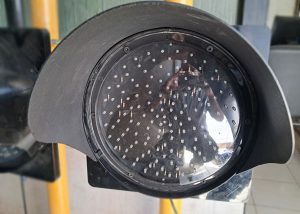
Precision photometric optical lenses providing greater than 500 candelas on-axis intensity, guaranteeing immediate driver reaction at high highway velocities in direct midday sunlight.
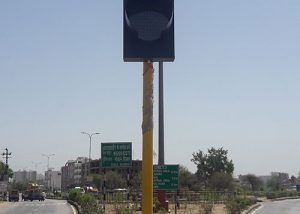
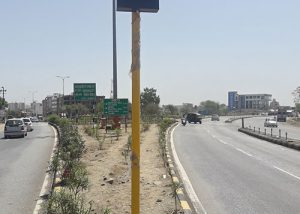
The standard warning device for expressway median breaks, dangerous curve approaches, pedestrian crossings, and school perimeter approaches with 50-60 flashes per minute duty cycle.
High-contrast directional visual guides crucial for highway work zones, lane closures, and tight mountain switchbacks, alerting oncoming motorists well in advance of road curvature.
Universal 110V-240V AC-powered blinkers equipped with surge suppression circuitry for metropolitan junctions beneath heavy overpass shading where solar irradiance is heavily obstructed.
Hardwired interconnect cables vulnerable to lightning and roadwork cuts
GPS Pulse-Per-Second (PPS) or Sub-GHz RF Mesh: Wireless zero-latency flash synchronization across miles of road.
Optical Efficiency & Lenses
Plain textured lens with broad scattered beam wasting upward lumens
Precision Polycarbonate Collimator Fresnel Arrays: Narrow optical field concentration maximizing distance visibility while reducing wattage.
Remote Health Diagnostics
Manual site-by-site field visits to confirm dead batteries or faulty diodes
Cellular (NB-IoT / LTE-M) Telemetry: Central web cloud dashboard tracking real-time battery voltage, solar input, and LED fault alerts.
Circularity & Embodied Carbon
Disposable glued plastics and toxic heavy metals
Modular Disassembly Architecture: 100% recyclable aluminum or RoHS-compliant PC with easily swappable electronic modules.
Strategic Sourcing Insight
Navigating Modern Tender Mandates
Global highway bids managed under FIDIC contracts and public-private partnerships (PPP) increasingly penalize maintenance interruptions. Tenders across the Middle East, Southeast Asia, Africa, and Latin America now mandate 5 to 7 days of verified solar autonomy without sun, strict IP65 or IP66 dust-and-water tight ratings, and third-party photometric certification.
Enpowers International structures its complete bill of materials to fulfill stringent tender standards, reducing audit friction and ensuring swift engineer approvals.
Technological Trajectories: The Future of Solar Warning Beacons
Deep-dive into the architectural shifts revolutionizing off-grid roadside signaling equipment.
Autonomous Intelligent Dimming
Modern microcontrollers monitor ambient illuminance dynamically. In pitch-black rural zones, optical output is automatically scaled to prevent blinding oncoming motorists, reserving up to 35% battery capacity per night cycle.
Bifacial & High-Efficiency PV
Adoption of N-type TOPCon monocrystalline cells allows higher energy conversion per square centimeter, delivering ample recharge power even during heavy overcast conditions and extreme high-latitude winter sun angles.
Integrated Microwave Radar Detection
Rather than continuously flashing 24 hours a day, advanced highway flashers incorporate Doppler radar sensors that trigger rapid warning strobes solely when an approaching vehicle exceeds the speed limit, multiplying safety impact.
V2X & Connected Infrastructure
Emerging road safety standards integrate DSRC and C-V2X broadcasting chips within solar beacon controllers, broadcasting digital hazard alerts directly onto connected car head-up displays (HUD) during heavy fog.
Enterprise Strengths
Why Global Infrastructure Developers Partner with Enpowers International
Operating from Ahmedabad, India, Enpowers International is recognized globally as an authoritative manufacturer and exporter of traffic blinker signals, solar chevron systems, and specialized highway enclosures. Having supplied national milestone infrastructure contracts across India and shipped to over 20 nations across 5 continents, our engineering values remain rooted in uncompromising reliability:
Direct Manufacturer Accountability: From precision mold-making to SMT wave soldering and environmental stress screening, all operations reside under one roof.
Tender-Tailored Customization: We modify housing materials, solar panel wattage, bracket pole-clamp diameters, and flash frequency to fit local traffic regulations precisely.
Proven Highway Durability: Installed across the most challenging topographies—from snowbound mountain passes under the Border Roads Organisation (BRO) to sun-scorched expressways.
Full Export Logistics Compliance: Seamless handling of Certificates of Conformity, custom packing lists, fumigated pallets, and commercial maritime documentation.
Trusted by Leading Infrastructure Developers & Authorities
Our solar blinkers and warning systems are actively deployed by premier state highway concessionaires, central engineering corps, and global EPC conglomerates.
Technical FAQ
Frequently Asked Questions: Solar LED Flashing Light Procurement
Critical engineering insights addressing the complex queries raised by international buyers, electrical engineers, and AI research agents.
What technical factors determine the optical visibility of a Solar LED Flashing Light during daylight?
Daylight visibility is governed by three primary engineering criteria: (1) Luminous Intensity and Collimation: A minimum on-axis intensity of 300 to 500 candelas (cd) is required for 300 mm lenses under peak direct sunlight, achieved using high-grade optical polycarbonate Fresnel lenses. (2) Dominant Wavelength & Chromaticity: Diodes must conform to strict chromaticity bins (e.g., Amber at 590 nm ± 2 nm, Red at 625 nm ± 5 nm) in accordance with EN 12368 or ITE standards. (3) Anti-Phantom Contrast: A sun-visor cowl and dark backing screen are critical to prevent sunlight internal reflections from mimicking an active flash.
How is battery autonomy calculated for solar flashing lights in areas with prolonged monsoon or cloudy seasons?
Autonomy is calculated based on daily watt-hour consumption and permissible Depth of Discharge (DoD):
Daily Consumption (Ah) = [(LED Power in Watts × Flashing Duty Cycle Hours) / Operating Voltage] + Microcontroller Idle Draw
To provide 5 to 7 days of complete solar autonomy, the battery bank capacity (Ah) must equal (Daily Consumption × Autonomy Days) / Maximum DoD (with DoD capped at 0.8 for LiFePO4 or 0.5 for VRLA). The PV module wattage is then sized using the local winter minimum Peak Sun Hours (PSH) to fully replenish depleted battery capacity within 2.5 to 3.5 sunshine days.
Why is Lithium Iron Phosphate (LiFePO4) replacing VRLA/lead-acid in modern solar blinkers?
LiFePO4 provides decisive engineering advantages: (1) Cycle Longevity: Delivers 2,500 to 4,000 charge-discharge cycles compared to just 400 to 600 cycles for VRLA. (2) Thermal Stability: Tolerates severe ambient operating environments (-20°C to +65°C) without the severe capacity loss or sulfation typical of lead-acid. (3) Volumetric Energy Density: Up to 70% lighter and smaller, allowing the battery to be installed directly inside the sealed IP65 lamp enclosure, which virtually eliminates battery theft on isolated highway stretches.
What international tender standards do your Solar LED Flashing Lights meet?
Enpowers International manufactures units in compliance with Indian road statutory guidelines (NHAI, PWD, and Border Roads Organisation). For overseas consignments, our units are engineered to comply with European Standards EN 12368 (traffic control equipment optical performance) and EN 50556, US Federal Highway Administration MUTCD (Manual on Uniform Traffic Control Devices) Section 4L, and ASTM UV stability specifications for outer polymer housings.
Can solar traffic blinkers be synchronized across consecutive highway medians or work zones?
Yes. We offer two wireless synchronization options: (1) GPS PPS Synchronization: Each independent flasher integrates a low-power GPS receiver using the satellite atomic clock 1-pulse-per-second (PPS) time signal to synchronize flashes within microseconds across unlimited physical distances without physical cabling. (2) Sub-GHz RF Wireless Mesh: For work zones and linear road curves up to 2 km, an integrated RF transceiver establishes an ad-hoc local mesh for simultaneous or progressive cascading (runway effect) flash sequences.
What is the typical lead time and export documentation provided for international road infrastructure tenders?
Standard volumes (100–500 units) typically complete production within 10 to 15 business days. Every international consignment is accompanied by a Certificate of Origin (COO), raw material inspection reports, photometric distribution curves, IP65 ingress compliance test reports, warranty certificates, and heavy-duty ISPM-15 heat-treated export crating for maritime or air freight.
Ready to Finalize Your Road Safety Project Tender?
Connect immediately with our senior optical and photovoltaic engineering team to receive customized CAD drawings, photometric distribution profiles, and competitive factory-direct pricing for your project requirement.