Highway Core
Solar Traffic Signal Blinker
Integrated 300mm or 200mm single-aspect hazard beacon equipped with high-efficiency monocrystalline solar panels and deep-cycle autonomy. Proven on median barriers and expressway crossovers.




A Solar Hazard Warning Light serves as the primary visual defense against vehicular collisions, worker hazards, and structural strikes across modern transportation and industrial infrastructures. Engineered with high-flux LED clusters, high-efficiency photovoltaic modules, smart charge controllers, and industrial-grade energy storage, these autonomous signaling devices deliver fail-safe visibility across critical conflict points without the trenching expenses and vulnerability of utility grids.
Manufactured by Enpowers International in Ahmedabad, Gujarat, India, our solar warning signals are designed to withstand high thermal variation, prolonged monsoon overcast, and abrasive wind loads. Compliant with NHAI, PWD, BRO criteria and customizable to US MUTCD and European EN 12352 parameters, our equipment safeguards high-speed corridors, mining yards, toll approaches, and work zones in over 20 countries.

Fabricated at Plot No. 140, Pushpak Industrial Estate, GIDC Phase-1, Vatwa, Ahmedabad. We control the complete engineering chain: optical design, solar sizing, CNC chassis fabrication, and sealed endurance testing.
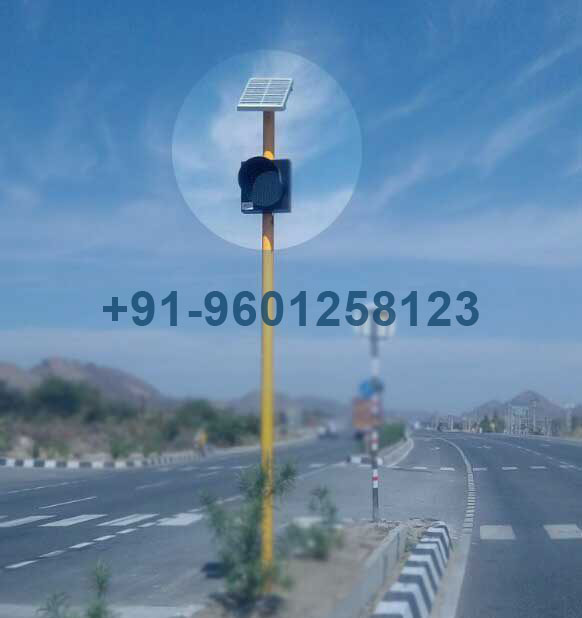
Explore field-tested signal configurations engineered for specific optical ranges, regulatory bodies, and operational conditions.
Integrated 300mm or 200mm single-aspect hazard beacon equipped with high-efficiency monocrystalline solar panels and deep-cycle autonomy. Proven on median barriers and expressway crossovers.

590nm dominant wavelength amber flashers designed for speed table warnings, sharp horizontal curves, intersection approaches, and school crossings. Penetrates dense fog and rain conditions.
625nm red hazard beacon deployed for railway level crossing warnings, dead-end road markers, industrial security gates, and emergency stop signaling. High-candela pulsed output for rapid driver reaction.

Directional chevron and arrow flasher arrays engineered for lane merge bottlenecks, construction bypass detours, and toll island segregations. Reconfigurable chevron flashing modes.
Complete pre-wired infrastructure kit including UV-stabilized optical head, pole mounting collar, solar module swivel bracket, lockable battery cabinet, and factory-calibrated charge controller.
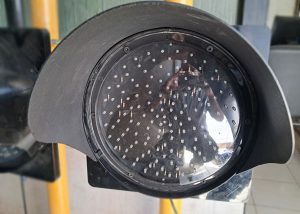
Heavy-duty corrosion-resistant polycarbonate and aluminum enclosures with neoprene gasket seals. Engineered to withstand high ambient temperatures, UV degradation, and dust ingress.

110V/230V AC grid-powered LED warning flashers designed for dense urban corridors, overpass shadows, or subterranean approach tunnels where direct solar harvesting is physically unviable.

Precision LED arrays featuring constant-current driver circuits, wide-angle dispersion fresnel lenses, and solid-state PWM controllers for uncompromised operational lifespan.
In-depth technical analysis for EPC contractors, highway concessionaires, and governmental road development authorities.
Global procurement metrics demonstrate a decisive shift away from Valve Regulated Lead-Acid (VRLA) and traditional Gel batteries toward Lithium Iron Phosphate (LiFePO4) storage cells. While VRLA chemistries degrade after 400–600 cycles (especially in tropical ambient temperatures above 40°C), LiFePO4 cells maintain over 80% state-of-charge capacity through 2,500 to 3,000 cycles. This transition slashes lifecycle battery replacement overheads, eliminates acidic fumes, reduces overall pole-head payload weight, and mitigates scrap theft risks.
Governmental tenders increasingly mandate compliance with strict performance-based parameters rather than simple dimensional specs. Buyers require verifiable certification under US FHWA MUTCD Section 4L/6F, European Standard EN 12352 (specifying luminous intensity classes L8H and L8L), and Indian National Highways Authority (NHAI) road safety standards. Sourcing bodies no longer accept commercial-grade luminaires lacking third-party photometric and ingress test documentation.
Public-Private Partnership (PPP) concessions and Build-Operate-Transfer (BOT) highway projects increasingly include environmental performance benchmarks. Utilizing solar hazard warning lights completely removes trenching, underground conduit piping, step-up transformers, and ongoing electrical consumption billing. In turn, EPCs achieve significant direct cost savings per kilometer while fulfilling strict green procurement covenants.
Leading institutional buyers evaluate bids based on 5-to-10 year TCO models rather than lowest initial invoice value. Low-grade warning lights using degraded recycled plastics and cheap epoxy LEDs suffer lens yellowing, solar delamination, and electronic board burnout within 12 months. Enpowers International’s deployment of virgin Bayer Makrolon® polycarbonate, automated SMT LED pick-and-place manufacturing, and sealed potting compounds guarantees multi-year uninterrupted duty cycles.
Complex infrastructure projects cannot tolerate middleman delays, ambiguous warranty clauses, or sub-tier trading markups. Global buyers are transitioning directly to proven original equipment manufacturers who control fabrication, assembly, photometric profiling, and export documentation in-house. This guarantees direct engineering revisions, tailored mast brackets, customized flash cycles, and responsive post-sales technical support.
Examining the engineering breakthroughs driving luminous output, energy autonomy, and real-time connectivity.
Modern warning systems incorporate NB-IoT, LoRaWAN, and 4G communication units. Centralized traffic operations receive real-time alerts regarding battery voltage sag, solar yield drops, or physical unit displacement.
Integrated ambient lux photodiode sensors dynamically regulate LED drive currents. Units deliver maximum high-candela burst during blinding sunlight and reduce output at night to avoid driver glare while conserving energy.
High-transmittance optical grade polycarbonates paired with computer-modeled internal TIR (Total Internal Reflection) and micro-prismatic fresnel geometry provide uniform light spread up to 30° horizontal viewing angles.
Microcontroller-governed Maximum Power Point Tracking (MPPT) circuits boost energy harvesting efficiency by 20% to 35% compared to basic shunt PWM designs, ensuring reliable battery recovery during winter months.
Evaluate exact parametric thresholds to ensure tender document compliance and verify engineering baselines across climatic extremes.
Need customized aspect dimensions, specific duty flash rates, or certified wind load calculations? Our Ahmedabad engineering office provides project-specific submittals within 24 hours.
Inquire Now| Subsystem | Industrial / Standard Spec | Enpowers International Specification | Operational Impact |
|---|---|---|---|
| Optical Aspect | 200 mm (8 inch) or 300 mm (12 inch) | 200 mm / 300 mm / 400 mm custom configurations | High-candela driver recognition exceeding 1,000 meters |
| LED Light Engine | Discrete 5mm DIP LEDs | High-flux AlInGaP SMT LEDs (>100,000 hrs rating) | Superior thermal dissipation; zero chromatic drift |
| Luminous Intensity | 300 - 400 cd peak | 500 - 800+ cd selectable (Compliant with EN 12352 L8H) | High daytime contrast even against direct low solar glare |
| Housing Material | Standard recycled ABS / Thin sheet | UV-stabilized virgin Polycarbonate / CRCA powder-coated | Impact resistance IK08-IK10; no structural embrittlement |
| Ingress Rating | IP54 to IP55 | Certified IP65 / IP66 enclosure sealing | Prevents moisture, driving rain, and sand intrusion |
| Solar Module | 10W to 20W Polycrystalline | 20W to 60W Grade-A Monocrystalline Perc Cells | Rapid replenishment even during low-irradiance overcast |
| Energy Storage | VRLA AGM Lead-Acid (12V) | LiFePO4 12.8V (Optional deep-cycle gel VRLA) | 2,500+ operational cycles; wide thermal resilience |
| Autonomous Backup | 2 to 3 Days | 5 to 7 Continuous Days (120 - 168 hours zero-sun) | Guaranteed signaling continuity during monsoon seasons |
| Flash Frequency | Fixed 50 flashes/min | Adjustable 40 to 60 FPM; pulse width 10% - 30% duty | Precise alignment with regional transportation mandates |
Setting the benchmark in solar road safety lighting infrastructure through direct plant ownership, uncompromising QA, and global project delivery.
Headquartered in Ahmedabad, Gujarat, we manufacture from raw polycarbonates and circuit assembly to complete integration. Zero trading overheads, guaranteed component traceability, and factory-direct pricing.
Our solar hazard blinkers are built to the demanding standards of the National Highways Authority of India (NHAI), Central PWD, and Border Roads Organisation (BRO), ensuring robust field reliability.
Supplying major national infrastructure developments, deep-sea ports, and mining facilities across the Middle East, Africa, Southeast Asia, and Europe with comprehensive export-grade packaging and logistics support.
We tailor optical lenses, mast arm clamp diameters, chassis powder coating, and solar sizing based on the exact solar insolation levels and wind loading charts of your installation site.
Supplying premier contractors, highway concessionaires, and transport authorities worldwide.



















Direct technical explanations to the top queries raised by global procurement officers and project engineers.
Solar warning beacon autonomy sizing relies on precise energy balance modeling. First, calculate the daily operational energy demand: Edaily (Wh) = LED Wattage (W) × Duty Cycle (%) × 24 hours. For an 8W LED head operating at 50% flash duty cycle, daily consumption is 96 Watt-hours. Second, multiply this by the specified autonomy days (typically 5 to 7 overcast days) and divide by the allowable Battery Depth of Discharge (DoD) — 80% for LiFePO4 or 50% for Gel lead-acid — adjusting for temperature derating. Solar module wattage is calculated using the minimum peak sun hours (PSH) during the winter solstice: Module Watts = (Edaily × Safety Factor 1.35) / Minimum PSH. This prevents system blackouts during heavy monsoons or winter cloud cover.
Solar hazard warning lights must comply with recognized international roadway performance standards, primarily US MUTCD Section 4L/6F, European Standard EN 12352 (Traffic control equipment - Warning and safety light devices), and Indian IRC:SP:84 / NHAI specifications. Key compliance metrics include minimum on-axis luminous intensity (typically Class L8H >1500 cd for high-speed daylight approaches or Class L8L >250 cd for nocturnal work zones), dominant color chromaticity boundaries (Amber: 585–595 nm; Red: 620–630 nm per CIE 1931), optical uniformity, and effective flash rates (40 to 60 flashes per minute with a minimum 100ms dwell time) to ensure clear driver reaction time from 1,000 meters away.
Lithium Iron Phosphate (LiFePO4) has become the gold standard in highway signaling infrastructure due to significant technical advantages over traditional Valve Regulated Lead-Acid (VRLA):
Severe highway and coastal environments require minimum IP65 ingress protection under IEC 60529, which guarantees complete sealing against dust ingress (dust tight) and low-pressure water jets from all directions. For high-humidity coastal corridors subject to tropical cyclones or direct sea spray, IP66 is recommended. Enclosure materials should utilize UV-stabilized, non-yellowing virgin polycarbonate (GE Lexan / Bayer Makrolon) or electrostatically polyester powder-coated marine-grade aluminum (minimum 80 microns thickness) with 316 stainless steel external fasteners to prevent galvanic corrosion and environmental stress cracking under prolonged ASTM B117 salt spray exposure.
To streamline customs clearance and fulfill tender criteria for international contractors, Enpowers International provides complete documentation dossiers: Certificate of Origin (COO / Chamber Legalized), manufacturer’s warranty certificates, photometric test reports (goniophotometer color and candela profiles), third-party lab IP65/IP66 ingress certificates, battery MSDS, UN38.3 lithium air/sea transport certification, Bill of Lading / Airway Bill, certified packing lists with palletized dimension sketches, and customized HS Code declarations (HS Code 8530.80 / 8541.40). Every batch undergoes factory acceptance testing (FAT) before export dispatch.
Yes. As an original equipment manufacturer based in Ahmedabad, Enpowers International tailors all functional parameters to project blueprints. We customize lens aspect configurations (single, dual alternating, directional chevron arrows), lens diameters (200mm, 300mm, 400mm), mounting bracket collars to fit existing round or octagonal poles (2-inch to 4-inch outer diameters), autonomous battery reserve days, and programmable micro-controller flash profiles (single flash, double strobe, night-only activation via LDR sensing, or continuous 24-hour operation).
Connect with our technical export division in Ahmedabad for factory-direct quotes, customized tender specifications, and rapid delivery schedules.