Export Sales: +91 96012 58123[email protected]Exporting to 20+ Countries
20+ CountriesGlobal highway deployments
NHAI / PWD / BROCompliant to ASTM & EN
100% In-HouseGIDC Vatwa, Ahmedabad
Up to 7 DaysEngineered cloudy autonomy
Engineering Specification Benchmark
Highway Solar Blinker Light: Engineering & Global Procurement Guide
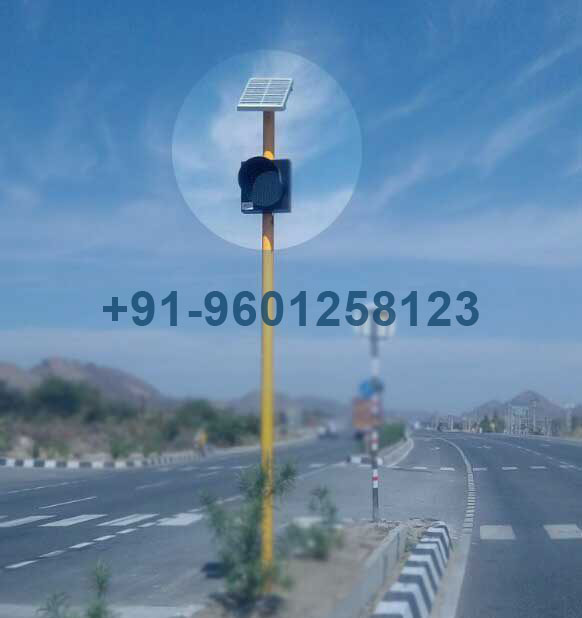
In high-speed transportation infrastructure, visual hazard identification is the first line of defense against catastrophic roadside collisions. A Highway Solar Blinker Light is an autonomous, standalone solid-state signaling system engineered to deliver persistent, high-intensity optical warnings at hazardous road profiles—including high-speed median noses, deceleration ramps, rural intersections, toll plaza approaches, and bridge abutments. Operating completely off the electrical grid, these devices convert solar irradiance into electro-chemical energy to maintain critical visual signaling through severe blizzards, desert sandstorms, monsoons, and extended low-insolation weather cycles.
For infrastructure concessionaires, ministries of transport, and civil EPC contractors, choosing a roadside flasher is a high-stakes engineering balance between photometric compliance, electrochemical autonomy, and structural resilience. Field failures lead to black spots, liability claims, and expensive emergency interventions on live expressways. Enpowers International engineers and manufactures specialized highway solar blinkers at our modern facility in Ahmedabad, Gujarat, India. By merging precision optical lenses with smart micro-controllers and high-efficiency photovoltaic assemblies, we supply tier-one road infrastructure projects across 20+ countries, delivering failure-free autonomous operation under rigorous ambient extremes from -20°C to +65°C.
Engineered to NHAI, PWD, BRO, and EN 12352 / MUTCD
UV-stabilized polycarbonate and die-cast IP65 housings
LiFePO4 and deep-cycle battery autonomy up to 7 continuous overcast days
In-house optical testing, chromaticity mapping, and burn-in screening
Precision-built under the Make in India manufacturing initiative at GIDC Vatwa, Ahmedabad. Complete vertical integration guarantees direct factory accountability without intermediary markups.
Explore field-proven solar hazard flashing systems engineered for national corridors, mountain bypasses, municipal highways, and high-speed work zones.
Our flagship 300 mm aspect designed for high-speed national expressways. Features ultra-bright amber/red OSRAM or Nichia LEDs with wide-angle prismatic Fresnel lenses, maintaining driver visibility at distances over 1,000 meters in dense fog and heavy rain.
The universal caution signal for median openings, flyover merge lanes, and blind curves. Incorporates an autonomous PWM/MPPT solar controller with auto-dimming ambient light sensors to prevent driver blinding at night while saving battery capacity.
Mandatory signal aspect for emergency crossovers, railway level crossings, and critical hazard barriers. Engineered with narrow-tolerance 625 nm red LEDs to trigger immediate decelerations from long stopping distances.
Directs traffic flow dynamically during lane drops, work zone diversions, and toll canopy lane shifts. Configurable in left, right, or bi-directional chevron flashing patterns with full solar self-containment for rapid repositioning.
Future Procurement Trends in Highway Solar Warning Systems
How global transportation authorities and EPC infrastructure developers are shifting specifications from low-cost commodities to high-reliability, lifecycle-cost-optimized roadside assets.
Lithium (LiFePO4) Dominance
Global highway tenders have rapidly deprecated lead-acid/SMF batteries in favor of Lithium Iron Phosphate (LiFePO4). With 2,500+ charge cycles, higher energy density, and superior thermal stability above 50°C, LiFePO4 eliminates costly 18-month battery replacements on remote highways.
IoT Health Telemetry
Highway concessionaires are demanding 4G/NB-IoT micro-transceivers inside solar blinker enclosures. Central Traffic Operations Centers (TOC) receive automated alerts for solar module shading, low battery state-of-charge, optical lumen depreciation, or structural tilt after vehicular impacts.
Smart Ambient Light Throttling
Modern highway procurement explicitly penalizes static-lumen flashers. Advanced tenders mandate multi-stage dusk-to-dawn photosensors that deliver 1,000+ candelas during blinding afternoon sunlight, then drop power to 300 candelas at midnight to eliminate glare and conserve battery capacity.
Unified Housing Standardization
Agencies now reject separate external battery boxes due to vandalism and corrosion risks. Procurement guidelines specify monoblock unibody designs, integrating the solar charge controller, LiFePO4 battery pack, and LED head inside a single IP65/IK08 polycarbonate enclosure.
Technological Evolution
Technological Trajectory: What Next for Highway Solar Blinkers?
From simple analog pulsing beacons to synchronized, intelligent roadside safety network nodes.
Innovation Highlights
Autonomous Highway Safety Networks
The role of the highway solar blinker light is transforming from an isolated flashing beacon into a connected, intelligent highway communication node. By integrating RF wireless meshing and V2X infrastructure protocols, solar blinkers act as active safety nodes communicating directly with human drivers and autonomous vehicular perception stacks.
Enpowers International leads this transition, designing modular hardware capable of integrating next-generation radar triggers, synchronized wave sequencing, and smart infrastructure networks.
For high-speed horizontal curves and complex detour tapers, unsynchronized random flashing creates visual clutter and driver disorientation. Sub-GHz wireless RF meshing enables sequential "running wave" flashing across 20+ linked solar blinkers without physical wires, directing vehicle trajectory through sharp road shifts.
PHASE 2
Microwave Radar Speed-Activation
Continuous flashing can cause sensory adaptation, causing frequent commuters to overlook warning signals. Next-generation blinkers integrate K-band Doppler radar units. The light remains in a low-intensity resting mode until an approaching vehicle exceeds safe speed thresholds, triggering an emergency high-frequency warning burst that commands immediate driver focus.
PHASE 3
N-Type TOPCon Solar Cells & Solid-State Batteries
By replacing legacy polycrystalline panels with N-type TOPCon monocrystalline cells, conversion efficiency exceeds 22.5%, allowing smaller solar panels with lower wind loads. Pairing this with emerging solid-state battery technology eliminates thermal runaway risks entirely in extreme desert operating environments.
Engineering Specifications
Technical Parameter & Compliance Matrix
Comprehensive engineering reference for tender preparation, technical submittals, and site validation.
Highway Solar Blinker Light Technical Specifications Matrix
Highway Solar Blinker Light: Frequently Asked Questions
In-depth technical answers addressing the real questions highway engineers, tender directors, and global EPC buyers ask in AI search engines and technical boards.
How is battery autonomy calculated for highway solar blinker lights in cloud-prone regions?
Accurate autonomy sizing requires calculating daily consumption: multiply peak LED cluster draw by the flashing duty cycle (typically 15% to 20%), then add the quiescent current of the controller and sensors. For example, a 12V 10W LED cluster operating at a 15% duty cycle consumes 1.5W average power, or 36 watt-hours per 24-hour cycle. To calculate required battery reserve, divide total watt-hours by nominal voltage (36Wh / 12V = 3.0Ah daily). For 5 continuous zero-sun days, total reserve equals 15Ah. Factoring in a maximum 80% Depth-of-Discharge (DOD) to preserve battery longevity and a 10% thermal derating factor, the minimum battery capacity should be 21Ah (LiFePO4). Selecting under-sized batteries is the primary reason budget blinkers fail during extended winter rains.
What are the critical photometric differences between 200 mm and 300 mm highway blinkers?
The primary differentiation lies in the optical sight distance and stopping sight distance (SSD) dictated by highway design speeds. A 200 mm lens aspect delivers an effective optical detection distance of 300 to 450 meters, making it ideal for urban roads, collector junctions, and speeds up to 60 km/h. Conversely, a 300 mm lens aspect uses larger Fresnel lenses and higher LED counts to output 800+ cd on-axis, providing sight lines exceeding 1,000 meters. For high-speed expressways operating at 100 to 120 km/h, 300 mm units are mandatory to ensure drivers have the 7 to 9 seconds of reaction time needed to safely change lanes or decelerate.
How do Enpowers solar blinkers comply with international standards like EN 12352 or MUTCD?
Enpowers International manufactures to the highest highway specifications in India (NHAI, PWD, BRO) and configures overseas orders to comply with European Standard EN 12352 (Warning and Safety Light Devices) and the US Federal Highway Administration MUTCD Section 4L. We adjust LED chromaticity within standardized CIE 1931 coordinate boundaries, tune flash profiles to 50-60 flashes per minute, maintain ingress ratings of IP65/IP66, and verify class L8H / L8M luminous intensity output using our in-house optical testing chambers.
Why is Lithium Iron Phosphate (LiFePO4) replacing VRLA/SMF in highway solar installations?
Traditional Sealed Maintenance-Free (SMF) or Valve Regulated Lead-Acid (VRLA) batteries suffer severe capacity loss and plate sulfation when exposed to operating temperatures above 40°C, requiring replacement every 12 to 18 months. In contrast, LiFePO4 chemistry supports continuous operation up to 60°C, delivers 2,000 to 3,000 deep discharge cycles (a 5-7 year operating life), and weighs 70% less. The lighter weight allows the battery to be safely mounted on poles inside tamper-proof enclosures, protecting the system from highway vandalism and ground moisture.
Can Enpowers supply customized flashing arrays for highway diversions and bridge projects?
Yes. As a genuine Indian equipment manufacturer with our own electronics assembly lines, CNC machining, and tooling facilities, Enpowers International provides complete customization. We configure twin-aspect alternating flashers, solar chevron arrays, directional dynamic arrows, custom mounting clamps (for round, octagonal, or swaged poles), and variable watt-peak solar arrays matched to project coordinates and tender drawings.
Why Global Concessionaires & EPCs Partner with Enpowers International
Procuring road safety products for major infrastructure requires verifiable manufacturing capabilities, strict quality assurance, and dependable delivery schedules. Enpowers International stands out among global suppliers through direct manufacturing and proven engineering reliability:
Direct Factory Production: Zero middleman markup; direct technical discussions with design engineers.
Tender-Compliant Builds: Fully documented to NHAI, PWD, BRO, and international highway standards.
Rigorous Quality Control: 100% 72-hour burn-in testing, IP ingress verification, and optical lux measurements.
Turnkey Export Service: Seaworthy export packaging, air freight capability, and full clearance documentation across 20+ countries.
Whether you need a single median solar warning beacon or thousands of units for national expressway expansion, our engineering team provides end-to-end support—from initial sizing calculations to final site commissioning.
Trusted by Highway Authorities & Global EPC Contractors
Our solar blinkers, chevron arrays, and traffic signals are trusted by national road agencies and multinational infrastructure developers.
Specify High-Performance Solar Blinkers for Your Highway Project
Connect with our technical engineering team in Ahmedabad for tender compliance evaluations, customized solar insolation calculations, and competitive factory-direct export proposals.