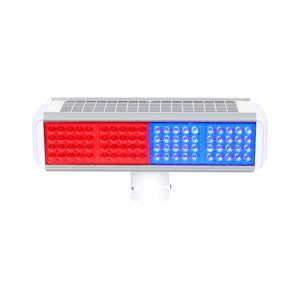
Integrated Solar Barricade Warning Light (Red/Blue)
Delivers 1,000m visual range with enhanced high-wind aerodynamic tolerance for roundabouts and high-speed road dividers.

Tested under rigorous industrial criteria for highway medians, construction hazard perimeters, bridge works, and smart urban crossings.
Delivers 1,000m visual range with enhanced high-wind aerodynamic tolerance for roundabouts and high-speed road dividers.
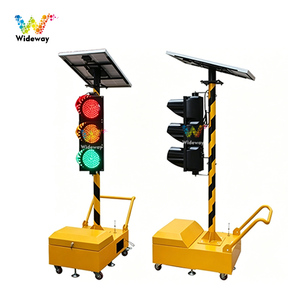
Multi-phase synchronized portable traffic management light equipped with long-distance wireless telemetry for flexible work zones.
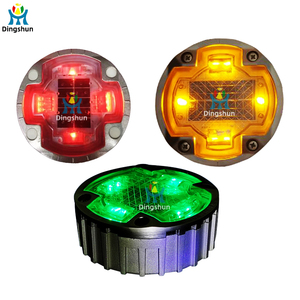
Cast aluminum structural housing designed for dynamic vehicular impact, engineered for heavy freight lanes and high-speed motorways.
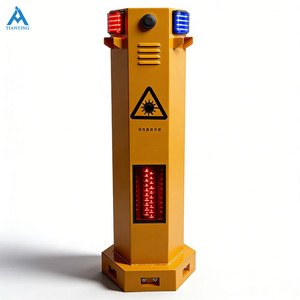
Combines active solar LED beaconing with ground-surface laser projection to drastically enhance pedestrian safety at nighttime zebra crossings.
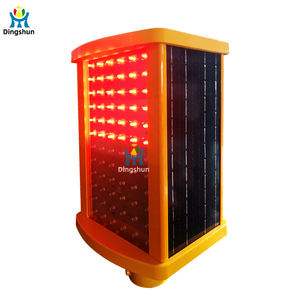
Industrial-grade poly-carbonate Fresnel optics delivering 360-degree high-candela strobe discharge for critical crash-barrier zones.
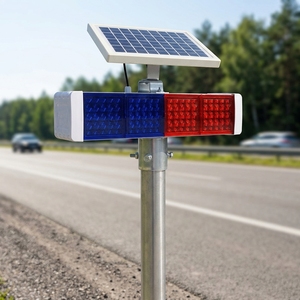
Designed for civil construction boundaries, high-risk security toll approaches, and severe emergency incident diversion.
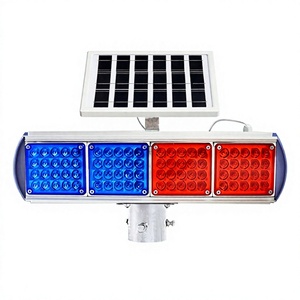
Engineered for seamless bracket attachment on permanent or temporary traffic direction signs with ultra-low thermal degradation.
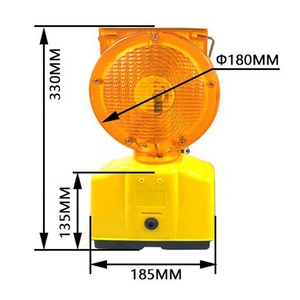
Autonomous day/night photo-sensor unit equipped with anti-theft anchoring hardware for perimeter highway road construction barriers.
Modern highway infrastructure projects cannot rely on decorative or low-lumen solar blinkers. When civil contractors, highway concessionaires, and municipalities source from solar warning beacon factories, products must withstand sustained thermal cycling, saline humidity, and deep battery discharge cycles. A systemic understanding of optical physics, semiconductor driver circuits, and energy storage chemistry separates benchmark manufacturers from generic suppliers.
A solar beacon's primary purpose is actionable driver warning at distances between 800 meters and 1,200 meters. High-reliability factories employ narrow-binning automotive-grade LEDs (such as Epistar, Cree, or Osram die architectures) mounted to metal-core printed circuit boards (MCPCBs) for rapid heat sinking. The optical lens requires optical-grade Polycarbonate (PC) treated with dual-side UV stabilizers to avoid yellowing and micro-crazing over a 5 to 7-year continuous outdoor operating life.
The chromaticity coordinates must comply strictly with international traffic regulations (CIE 1931 color space for Amber/Yellow: 590nm±3nm; Traffic Red: 625nm±5nm; Signal Blue: 465nm±5nm). Beacons utilizing diffuse or uncontrolled radiation patterns waste up to 40% of their luminous flux into the night sky. In contrast, precision Fresnel and total internal reflection (TIR) collimators concentrate light within a 15° to 30° horizontal viewing angle and a ±7.5° vertical field, ensuring that the driver's eye level receives the optimal candela flash without dazzling adjacent residential properties.
The most pervasive failure mode across off-grid solar warning beacons is inadequate autonomous sizing during sustained overcast, monsoon, or winter periods. Engineering best practices demand an Energy Autonomy Ratio of ≥ 5:1 (minimum 5 continuous overcast days or 120 operational hours without PV regeneration).
| Battery Chemistry | Thermal Window (°C) | Cycle Life (80% DoD) | Volumetric Density | Industrial Suitability |
|---|---|---|---|---|
| Lithium Iron Phosphate (LiFePO4) | -20°C to +65°C | 2,500 - 3,500 | High | Industry Gold Standard: Maximum safety, high thermal tolerance, low self-discharge. |
| Ternary Lithium (NMC) | -20°C to +55°C | 800 - 1,200 | Very High | Compact portable devices; requires specialized thermal run-away protection. |
| Valve-Regulated Lead-Acid (VRLA / AGM) | -10°C to +45°C | 350 - 500 | Low | Legacy projects; heavy weight, severe sulfation risk during deep cold snaps. |
Procurement specifications across state transport agencies and private EPC concessions are shifting towards autonomous intelligence and integrated hardware. The top three emerging trends driving global bids are:
Consecutive beacons communicating via sub-1GHz radio frequency (RF) to flash in a sweeping dynamic sequence, proving an 83% improvement in nighttime work-zone boundary perception.
Real-time remote diagnostics alerting municipal road maintenance dispatchers to battery drop-offs, panel shading from bird droppings, or structural impact knockdown.
Pulse Width Modulation (PWM) intelligence that adjusts flash luminous intensity according to ambient lux levels, eliminating visual glare at 2:00 AM while delivering maximum candela in harsh midday sun.
Direct manufacturing facility based in Ahmedabad, Gujarat, eliminating trading markups and delivering strict standard compliance.
Operating from GIDC Phase-1, Vatwa, Ahmedabad, we handle PCB assembly, lens molding, sealing injection, and continuous burn-in flash testing under one audited roof.
Fully compliant with NHAI, PWD, and Border Roads Organisation (BRO) specifications, with configurable firmware and hardware adhering to European (EN 12352) and American (MUTCD) mandates.
Specialized moisture-barrier maritime packing, complete customs dossier validation (Certificate of Origin, HS code verification), and seamless sea freight handling.
Critical engineering considerations addressed directly by our senior technical sales team.
Connect with our technical engineering desk in Ahmedabad to discuss custom bracket fabrications, project drawings, photometrics, and factory-direct volume pricing.
Send an Inquiry