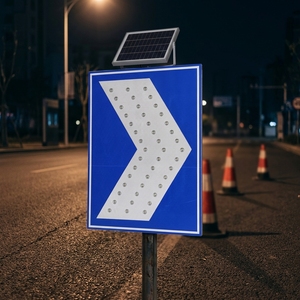
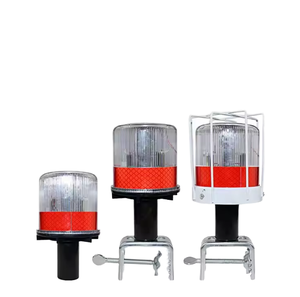
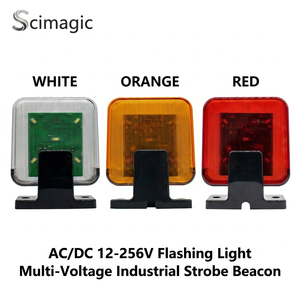
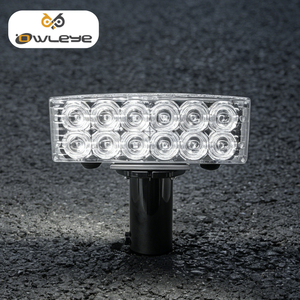
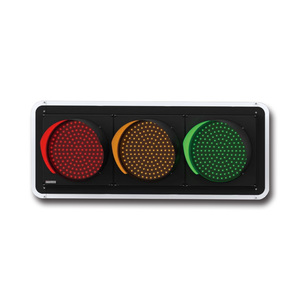
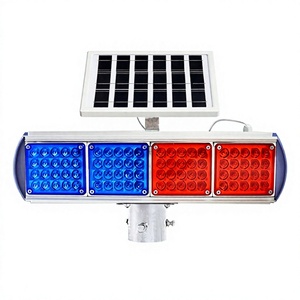
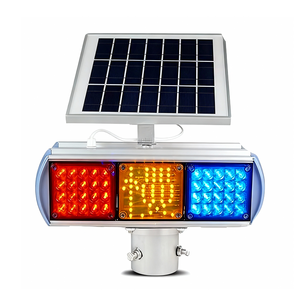
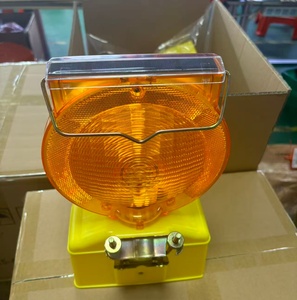
High-candela, impact-resistant, self-charging emergency warning devices engineered for extreme duty on international highways, construction work zones, and toll infrastructure.
As modern transportation networks scale toward smart corridors and zero-fatality initiatives, active optical delineation has superseded passive retroreflectivity as the primary line of defense. A solar road flare—also classified in heavy civil engineering as a solar-powered active warning beacon, median blinker, or barricade strobe—is an autonomous, solid-state warning system designed to eliminate collision hazards across high-risk vehicular transition zones.
Traditional chemical flares present immense operational challenges: they produce open flames, release hazardous perchlorate emissions, maintain an operating life of under 30 minutes, and pose grave burn risks to highway emergency crews. Contemporary solar road flares utilize wide-bandgap solid-state LEDs driven by low-loss microcontroller units (MCUs) powered by high-efficiency monocrystalline photovoltaic cells and sealed lithium iron phosphate (LiFePO4) storage batteries. Operating across visible ranges surpassing 1,000 meters under severe nocturnal fog, heavy rain, or blowing sand, these active devices convey unequivocal spatial awareness to commercial and civilian drivers traveling at high velocities.
With an integrated production footprint situated in GIDC Phase-1, Vatwa, Ahmedabad, Gujarat, India, Enpowers International operates not merely as an assembly exporter, but as a full-cycle research, die-casting, photometric-testing, and electronics manufacturing organization. Our supply chains bypass brokerage intermediaries, delivering verifiable reliability directly to municipal authorities, highway concessionaires, and general contractors spanning over 20 nations.
Every solar flare and warning blinker is certified to satisfy rigorous standards defined by the National Highways Authority of India (NHAI), Public Works Department (PWD), and Border Roads Organisation (BRO), while readily custom-configurable to EN 12352 (European) and MUTCD (American) standards.
Utilizing high-impact virgin polycarbonate lenses with anti-UV stabilizers and die-cast LM6 aluminum or virgin ABS structural housings, our solar warning beacons feature IP66 and IP68 hermetic ingress protection against corrosive de-icing chemicals, torrential rains, and desert sandstorms.
Equipped with intelligent energy optimization algorithms, internal MPPT (Maximum Power Point Tracking) micro-circuitry automatically dials pulse intensities dynamically relative to ambient lux levels, guaranteeing 5 to 7 continuous days of autonomous flashing through heavy monsoon downpours.
Procurement directors and municipal transport consultants are no longer acquiring road safety beacons based solely on unit pricing. Total Cost of Ownership (TCO), functional resilience, and digital compliance govern the upcoming cycle of cross-border tenders:
Traditional sealed lead-acid (SLA) and valve-regulated lead-acid (VRLA) batteries suffer from severe thermal degradation in sub-tropical and equatorial deployment zones, often experiencing catastrophic sulfation within 12–18 months. Modern infrastructure contracts explicitly demand Lithium Iron Phosphate (LiFePO4) chemistry, providing 2,000+ deep charge-discharge cycles, sustained operational integrity from -20°C to +65°C, and a maintenance-free lifespan exceeding 5 years.
Single, isolated flashing beacons are increasingly being phased out on multi-lane expressways in favor of RF-synchronized (Radio Frequency 2.4GHz / LoRa) flares. These devices flash either simultaneously or sequentially, creating a visual "runway sweep" illusion that safely channels vehicular flow past high-speed diversion zones without visual chaos.
Contractors require tool-less mounting options. Future procurement trends demonstrate accelerated demand for multi-use mounting interfaces: units that can be latched onto standard high-density polyethylene (HDPE) traffic cones, bolted onto galvanized steel W-beam guardrails, or magnet-mounted to highway maintenance trucks without bespoke hardware adapters.
To avoid tender disqualification and premature field failure, project engineers must align specifications with environmental and operational constraints. The following technical parameter matrix outlines key considerations:
| Evaluation Parameter | High-Speed Expressway / Highway | Urban Junction & School Zone | Temporary Construction Barricade |
|---|---|---|---|
| Optical Aperture | 300 mm (12") Ultra-Visible Lens | 200 mm (8") Focused Lens | Compact Dual-Faceted 100–150 mm Lens |
| LED Viewing Distance | > 1,000 meters in direct line of sight | > 500 meters in ambient city lighting | > 800 meters across work-zone corridors |
| PV Module Type | 10W–20W Monocrystalline (External) | 5W–10W Polycrystalline / Integrated | 2W–5W Integrated Impact-Proof Monocrystalline |
| Battery Storage | 12V 12Ah–18Ah LiFePO4 | 6V–12V 7Ah LiFePO4 / LFP | 3.2V–3.7V 2600–4400 mAh Industrial Lithium |
| Autonomy Reserve | Min. 7 days (continuous cloud/rain) | Min. 4–5 days autonomous backup | Min. 3–5 days active strobe capacity |
| Ingress / Impact | IP66 Enclosure / IK09 Mechanical Rating | IP65 Enclosure / IK08 Mechanical Rating | IP68 Waterproof / IK10 Drop Tested |
Connect directly with Enpowers International's engineering desk in Ahmedabad. Receive detailed product schematics, photometric reports, and competitive factory-gate quotations customized to your exact tender parameters.
Inquire Now