Export Sales: +91 96012 58123 [email protected] Exporting to 20+ Countries
Global Optical Warning & Intelligent Infrastructure Whitepaper

Top 10 Flashing Beacon Light Manufacturer & Factory

The 2025–2030 Engineering Procurement Handbook: Technical Standards, Photometric Compliance, Solar Autonomy, and Factory-Direct Supply Auditing.

20+ Export Sovereign Markets
NHAI / BRO Certified Specification Rigor
100,000+ Operating Field Hours MTBF
100% In-House Optical Testing
Precision Manufacturing Showcase

High-Performance Flashing Beacon Lights & Signals

Explore engineering-grade visual alerting equipment designed for industrial automation, high-speed highway construction, and off-grid hazard warning zones.

Engineering Whitepaper • Technical Overview

Deconstructing the Engineering Standards of Industrial Flashing Beacons

Flashing beacon lights constitute the primary tier of passive and active visual warning hardware across transportation corridors, petrochemical refineries, construction sites, and municipal roadways. In high-speed highway environments, reaction time is governed strictly by the luminous intensity (candela), chromaticity coordinate stability, and effective flash frequency of the beacon optical assembly.

Global project tenders—including standards codified by the National Highways Authority of India (NHAI), Central Public Works Department (CPWD), Border Roads Organisation (BRO), as well as American MUTCD (Manual on Uniform Traffic Control Devices) and European EN 12352 / ECE R65—demand strict adherence to photobiology and structural ingress durability.

Key Quality Metric: A Tier-1 manufacturing factory distinguishes itself by utilizing UV-stabilized Bayer Makrolon® or Sabic Lexan® polycarbonate lenses capable of retaining >92% light transmittance after 5,000 hours of accelerated Xenon arc weathering, paired with constant-current LED drive circuitry to prevent lumen degradation under thermal extremes (-40°C to +75°C).

Whether deploying an off-grid solar amber warning beacon for an unlit rural median cut or an AC-powered directional chevron strobe at a multi-lane expressway toll plaza, procurement teams must evaluate the total lifecycle cost (TCO). This encompasses ingress protection (IP65 up to IP68), internal thermal dissipation topologies, battery discharge depths (DoD), and autonomous reserve cycles during adverse meteorological periods.

Direct Factory Procurement Matrix

To eliminate tender rejection and ensure prompt approvals from consulting project engineers, always mandate these core factory verifications:

  • Lens Integrity: Impact rating IK08/IK10 with UV-380 stabilization.
  • Autonomy Sizing: Minimum 5 to 7 days backup for solar configurations.
  • Optical Compliance: EN 12352 Class L8H/L8L or SAE J845 Class 1/2.
  • Sealing Rating: Submersible IP67 / IP68 silicone continuous gasket.
Enterprise Value Proposition

Why Tier-1 Contractors Partner with Our Manufacturing Hub

Headquartered in Ahmedabad's premier industrial zone (GIDC Phase-1, Vatwa) and delivering to infrastructure projects across 20+ countries, our vertically integrated plant eliminates intermediary trading markups while enforcing uncompromising build quality.

Vertical In-House Production

From aluminum die-cast housings and UV-stabilized polycarbonate injection moulding to SMT LED placement and final potting, our entire lifecycle remains 100% in-house in Ahmedabad, India.

Tender-Specific Compliance

Pre-engineered documentation mapped precisely to NHAI, PWD, BRO, EN 12352, and MUTCD technical parameters for seamless pre-qualification bids, submittals, and site inspections.

Engineered Solar Sizing

We do not use generic solar pairings. Every solar module wattage and battery capacity (LiFePO4/NMC) is tailored scientifically to the installation latitude's Peak Sun Hours (PSH).

Export Logistics Reliability

Exporting to more than 20 countries worldwide with specialized multi-layer shockproof export packaging, complete COO documentation, HS-code alignment, and swift sea/air freight dispatch.

Industry Outlook • Next-Gen Technology

Future Procurement & Technological Trends in Warning Lights

The flashing beacon light domain is transitioning from isolated analog flashers to smart, networked hazard warning nodes. Discover the innovations steering international infrastructure tenders.

Smart Connectivity

IoT Telemetry & RF Synchronization

Modern highway tenders increasingly specify RF-mesh synchronized flashers for work zones. Rather than chaotic, uncoordinated flickering, adjacent beacons fire in sequential chevron patterns, creating an intuitive visual corridor that guides nighttime motorists safely past lane closures. Built-in NB-IoT and LoRaWAN transceivers alert maintenance depots remotely in the event of solar depletion, vehicle impact, or LED failure.

Energy Storage

Transition to Solid-State LiFePO4

Procurement departments are phasing out conventional Sealed Lead-Acid (SLA) and deep-cycle Gel batteries due to sulfation degradation and brief 2-year lifespans in tropical climates. Advanced specifications require integrated Lithium Iron Phosphate (LiFePO4) systems offering 3,000+ deep charge cycles (80% DoD), integrated BMS overheating safety cutoffs, and operating stability up to 65°C without thermal runaway.

Optics & Sensors

Dynamic Photometric Dimming Optics

To eliminate dangerous blinding glare for drivers during pitch-black nighttime conditions while guaranteeing intense daylight contrast under harsh mid-day sun, next-generation beacons utilize multi-stage pulse-width modulation (PWM) drivers linked with calibrated silicon photodiode sensors. The output dynamically steps from 100% candela at noon down to 25% at midnight, conserving precious energy while maintaining optimal safety recognition.

Specification Benchmark

Engineering Decision Matrix: Solar vs. Mains Power vs. Heavy Industrial

Review the primary technical tradeoffs to ensure your tender documents avoid under-specified hardware or redundant capital expenditures.

Evaluation Parameter Solar Warning Blinker (Off-Grid) Mains AC Electric Blinker (110V/230V) Heavy Industrial / Vehicle DIN Pole
Primary Application Highways, rural junctions, median cutouts Toll plazas, permanent signal corridors Tractors, escorts, forklifts, plant barriers
Installation Capex Low (Zero trenching, zero cabling) Medium (Requires conduit & grid hookup) Minimal (Direct DIN plug / magnetic mount)
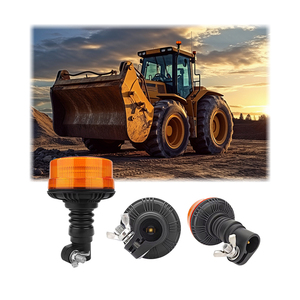
Photometric Output High pulsed candela (Class L8H duty cycle) Continuous high-flux output (Class L8M) Omnidirectional 360° rotating/flash strobe
Weather Autonomy 5 to 7 overcast days via internal storage Infinite (subject to utility grid reliability) Vehicle / Equipment alternator powered
Maintenance Profile Biannual lens and solar face dust wipe Virtually zero (sealed LED driver assembly) Periodic mechanical vibration check
Ingress Rating IP65 to IP67 sealed enclosures IP65 die-cast housing IP66 to IP68 submersible rubber base
Procurement Intelligence

Frequently Asked Questions by Infrastructure Buyers & Engineers

Direct technical answers addressing the real-world considerations of global contractors, tender committees, and concessionaires.

What distinguishes an authentic flashing beacon light manufacturer from an export trading firm?
An authentic manufacturer maintains physical production infrastructure, including tooling dies, injection moulding machines, SMT placement lines, robotic potting setups, and in-house photometric test darkrooms. Manufacturers like Enpowers International control production directly from GIDC Phase-1, Vatwa, Ahmedabad, India. Trading entities act merely as intermediaries with markups, lacking direct engineering control over LED binning, thermal dissipation, PCB revision tracking, or custom firmware flashing for tender compliance.
How do you calculate required solar panel wattage and battery capacity for warning blinkers?
Engineering calculation begins with daily Watt-hour (Wh) load: Wh = (LED Forward Power [W] × Flash Duty Cycle [%] × 24h) + Controller Quiescent Power. To determine battery capacity: Battery Ah = (Wh × Required Autonomous Days [typically 5]) ÷ (System Voltage [12V] × Max Depth of Discharge [0.80]). Solar module wattage is then derived by dividing the total daily energy requirement (factoring in 20% system wiring and dust losses) by the site's lowest historic monthly Peak Sun Hours (PSH). This prevents system blackout during extended monsoons or heavy winters.
What standard certifications are essential for road safety flashing beacons?
Depending on destination jurisdictions, tenders demand compliance with: India: IRC:SP:84, NHAI, PWD, and BRO technical schedules; Europe: EN 12352 (Traffic warning lamps), ECE R65 (Emergency vehicle optical output), and CE/RoHS; North America: MUTCD Section 4L/6F and SAE J845/J595 Class 1, 2, or 3 optical certifications. All units must undergo ingress verification to IP65 or IP67 in accredited testing laboratories.
Why are LiFePO4 batteries replacing Sealed Lead-Acid (SLA) in warning lights?
SLA batteries degrade rapidly in elevated ambient temperatures, frequently experiencing plate sulfation and cell failure within 12 to 18 months in roadside enclosures exposed to direct solar radiation. In contrast, Lithium Iron Phosphate (LiFePO4) chemistry delivers 3,000 to 5,000 cycles, tolerates high temperature operational envelopes (up to 65°C), exhibits zero off-gassing, provides a substantially smaller volumetric footprint, and yields a significantly lower 5-year total cost of ownership (TCO).
Can housings and flash patterns be customized for international turnkey projects?
Yes. Direct factory collaboration allows custom firmware coding for specific flash rates (e.g., 50 to 60 double flashes per minute per local code), multi-aspect synchronized wireless arrays, specific pole diameter clamp bracketry (50mm up to 114mm OD), custom Ral powder-coating colors, and client brand/tender plate engraving.

Accelerate Your Project Tender Approval

Procuring direct from our Ahmedabad manufacturing facility guarantees uncompromised photometric performance, certified tender compliance, and factory-direct pricing for contractors, concessionaires, and overseas distributors.

Online Enquiry Contact Sales