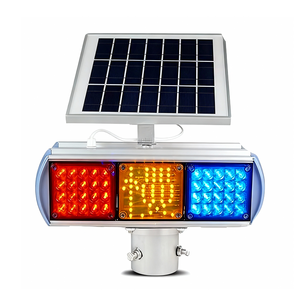
Explore our industrial-grade, pole-mountable, and modular solar warning signal systems designed for arterial highways, school hazard alerts, work zones, and roundabouts.
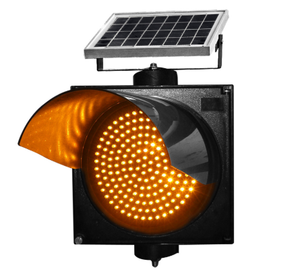
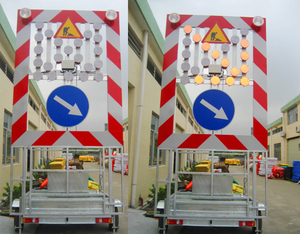
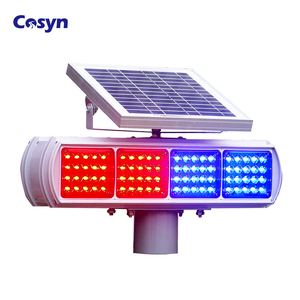
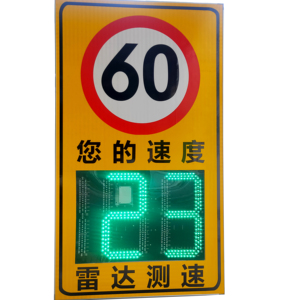
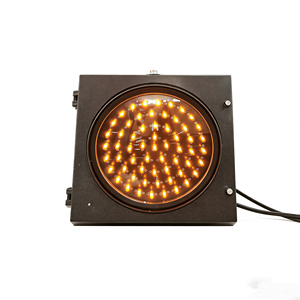
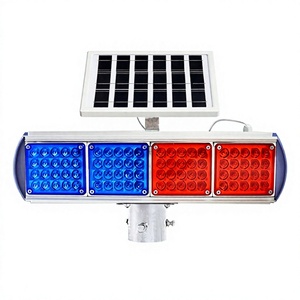

Operating out of our primary manufacturing facility at GIDC Phase-1, Vatwa, Ahmedabad, Gujarat, India, Enpowers International integrates precision photometric engineering, automated SMT board placement, and environmental stress screening under one roof.
Every solar sign flasher and traffic blinker system is engineered strictly to NHAI (National Highways Authority of India), PWD, and BRO (Border Roads Organisation) specifications. For international turnkey deployments, units are calibrated to MUTCD (US) and EN 12352 (European) Class L8H photometric ratings.
We eliminate roadside failure through exact climate-mapped solar sizing. We match high-efficiency monocrystalline solar modules with advanced Lithium Iron Phosphate (LiFePO4) battery packs, assuring up to 7 to 15 days of continuous flashing during sustained overcast monsoon or northern winter conditions.
From UV-stabilized pure virgin Polycarbonate (PC) injection moulding to pressure die-cast ADC12 aluminum housings, our in-house tooling division accommodates custom aperture diameters (200mm, 300mm, 400mm), mounting bracket geometries, and private-label branding for export projects.
| Engineering Parameter | Standard OEM Highway Baseline | High-Spec Municipal / Express Corridor | Tender Verification Method |
|---|---|---|---|
| Luminous Intensity (Amber) | ≥ 400 - 600 cd (On-axis) | ≥ 800 - 1200 cd (High-output Epistar/Nichia) | Goniophotometer Dark Room Testing |
| Photovoltaic Module | 12V / 15W - 20W Mono-PERC | 12V / 40W - 60W Mono-PERC (Anti-Soiling) | IEC 61215 / IEC 61730 Flash Report |
| Energy Storage Chemistry | LiFePO4 (12.8V / 12Ah - 18Ah) | LiFePO4 with BMS (12.8V / 24Ah - 42Ah) | UN38.3 • IEC 62133 Cell Certification |
| Optical Lens Construction | Impact UV-Resistant Polycarbonate Fresnel | Dual-layer Glare-reducing Collimator Lens | ASTM D1003 Light Transmission & Haze |
| Enclosure Protection | IP65 Dust & Water Jet Resistant | IP68 Hermetically Sealed Electronics Enclosure | IS/IEC 60529 Ingress Test Compliance |
| Operating Temperature | -10°C to +60°C | -30°C to +75°C (Extreme Altitude / Desert) | Thermal Shock Environmental Chamber |
The global intelligent transport systems (ITS) landscape is moving rapidly beyond static blinking beacons. Explore how modern optical designs, edge radar sensing, and battery chemistries are transforming road hazard communications.
Rather than continuous 24/7 flashing which causes driver desensitization and unnecessary battery drain, modern sign flashers incorporate 24GHz microwave Doppler radar sensors. The system remains in low-power idle until approaching over-speed vehicles are identified, triggering an urgent optical burst that reduces vehicle speeds by up to 23% in transition zones.
Traditional Lead-Acid (SLA/VRLA) batteries are obsolete due to thermal runaway in tropical heat and freezing capacity drop. Modern OEM solutions utilize Lithium Iron Phosphate (LiFePO4) cells coupled with integrated Maximum Power Point Tracking (MPPT) micro-controllers, yielding over 2,500 lifecycle cycles and 96% charging conversion efficiency.
For arterial bypasses, work corridors, and school zones, standalone flashers now integrate GPS pulse-per-second (PPS) synchronization and NB-IoT/4G telemetry. Multiple sign flashers blink in simultaneous unison without inter-connecting wires, while municipal engineers monitor battery voltage and LED diagnostics remotely via central SCADA dashboards.
Strategic purchasing managers and EPC concessionaires are revising their procurement parameters to optimize lifetime return on investment (ROI) and minimize maintenance liabilities.
Civil contractors are moving away from cheap, non-branded flashers that suffer solar panel browning and battery failure within 12 months. Global buyers now mandate verified MTBF (> 50,000 hours) LED packages and corrosion-resistant enclosures, eliminating costly crane rentals and lane closure permits for roadside service calls.
Modern government tenders increasingly stipulate modular components where the solar engine, controller card, and optical module can be detached with quick-disconnect IP68 aviation plugs without dismounting the signal mast. This reduces road closure maintenance windows from hours to under 8 minutes.
Global infrastructure consortiums operating cross-border projects require OEM manufacturers who can harmonize Indian NHAI, British BS EN 12352, and American MUTCD Section 4L/4S standards on a single hardware chassis, streamlining inventory skus across multi-national projects.
Comprehensive answers addressing photometric compliance, solar battery sizing, containerized export handling, and custom OEM manufacturing.
Enpowers International is a specialised manufacturer headquartered in Ahmedabad, Gujarat, India, with heavy fabrication and optical assembly situated at Plot No. 140, Pushpak Industrial Estate, GIDC Phase-1, Vatwa. We maintain dedicated tooling for polycarbonate signal heads, automated wave-soldering and SMT pick-and-place lines, and photometric calibration benches. Blinkers are fully assembled, pressurized for ingress testing, and burn-in tested in-house prior to export dispatch.
Our solar sign flashers comply comprehensively with the specifications laid down by the National Highways Authority of India (NHAI), Central Public Works Department (CPWD), and the Border Roads Organisation (BRO). For export tenders, our systems are pre-engineered to comply with the American Federal Highway Administration MUTCD (Section 4L flashing beacons) and European Standard EN 12352 (Traffic control equipment - Warning and safety light devices) Class L8H / L2H. Full photometric, IP68 environmental, and vibration test certificates are provided with every batch.
Autonomy is not estimated; it is mathematically modeled based on your installation latitude's Peak Sun Hours (PSH) during the winter solstice. We calculate the Daily Energy Consumption (DEC) based on LED forward voltage, pulse duty cycle (e.g., 50ms pulse, 50 flashes/min), and microcontroller quiescent draw. We then scale the LiFePO4 battery reserve to maintain the required non-sun autonomy (typically 7 to 15 days or 120-240 continuous hours) with a maximum 80% Depth of Discharge (DoD) to ensure a 7+ year battery service life.
Solar blinkers are optimal for expressways, rural highway median cut-throughs, sharp hairpins, construction work zones, and toll approaches where trenching, laying armored AC cable, installing transformers, and managing utility metering is cost-prohibitive. Standalone solar units eliminate tens of thousands of dollars per kilometer in electrical infrastructure. Conversely, AC electricity blinkers are suggested for heavily shaded urban intersections surrounded by high-rises or underground transit corridors where direct solar irradiation is obstructed.
We provide full bespoke OEM development: lens sizes ranging from 200mm (8-inch) to 300mm (12-inch) and 400mm; lens options in high-transmittance amber, ruby red, green, or dual-color chevron / directional arrows. Housing enclosures are offered in Bayer UV-stabilized impact-resistant Polycarbonate (PC), tough ABS, or high-tensile pressure die-cast ADC12 aluminum for marine and chemical industrial environments. Pole mounting brackets can be customized for tubular poles, octagonal high-masts, or gantry structures.
Enpowers International exports to more than 20 countries across North America, Europe, the Middle East, Southeast Asia, and Africa. All shipments comply with international maritime and air cargo regulations: UN38.3 test summaries and MSDS for lithium batteries, Certificate of Origin (COO), factory acceptance test (FAT) inspection reports, and CE/RoHS declarations. Hardware is packed in heavy-duty 7-ply export cartons, moisture-barrier wrapping, and ISPM-15 heat-treated fumigated wooden pallets.
Connect directly with our engineering and export desk in Ahmedabad to review project drawings, photometric requirements, and tender compliance documents.