
Manufactured in ISO9001:2015 accredited Chinese facilities featuring aerospace-grade aluminum housings, optical ultra-bright Epistar/Cree LED chips, and 3M Diamond Grade reflective sheeting.
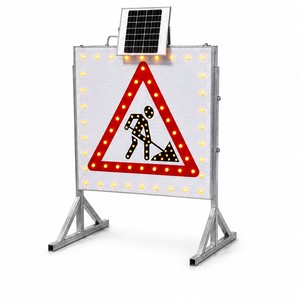

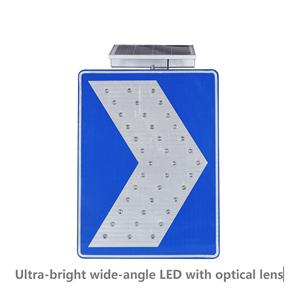
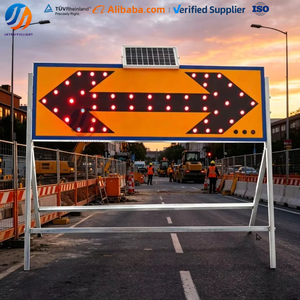
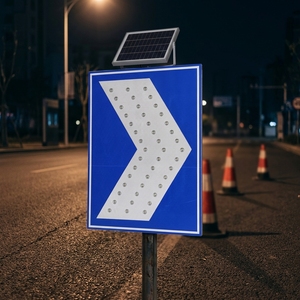
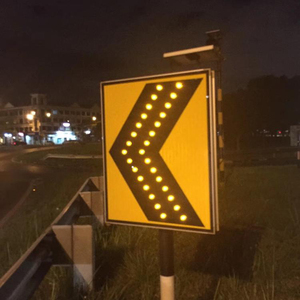
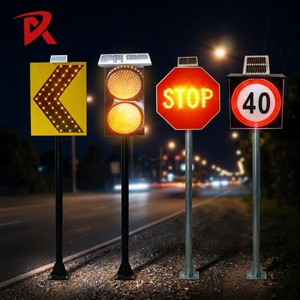
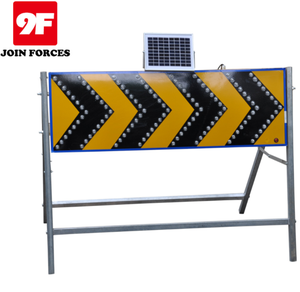
Horizontal highway curves represent one of the highest systemic collision risks in worldwide road networks. According to data consolidated from the Federal Highway Administration (FHWA) and global transport ministries, run-off-road collisions and head-on curve impacts account for over 25% of all fatal highway events, despite curve segments comprising under 10% of total lane mileage. In response, modern transportation engineering has shifted from passive retroreflective aluminum sign boards to active, electro-photometric solar chevron signs.
When procuring from leading Chinese solar chevron factories, procurement engineers and DOT project directors evaluate more than aesthetic dimensions. The core value of an active solar chevron lies in its ability to generate high contrast luminous guidance under suboptimal driving conditions: torrential monsoons, deep fog, alpine snowstorms, and pitch-black unlit rural corridors where headlights alone cannot provide sufficient recognition sight distance (RSD).
Leading China solar chevron factories employ strict military-grade surface-mount technology (SMT) packaging and conformal coating processes. The luminescent matrix consists of encapsulated InGaN (Indium Gallium Nitride) or AlInGaP (Aluminum Indium Gallium Phosphide) solid-state emitters positioned within secondary total internal reflection (TIR) optical lenses. This focuses light into a precise 30-degree horizontal conical envelope, preventing upward light pollution while eliminating glare for oncoming lanes.
The photovoltaic subsystem utilizes high-efficiency N-type monocrystalline solar cells with conversion efficiencies exceeding 22.5%. These are laminated under low-iron tempered solar glass utilizing cross-linked EVA (Ethylene Vinyl Acetate) and Tedlar-PET backsheets to survive intense UV exposure, salt spray, and acid precipitation. Intelligent pulse-width modulation (PWM) or Maximum Power Point Tracking (MPPT) micro-controllers regulate energy harvesting, dynamically throttling LED milliampere current according to ambient lux and battery state-of-charge (SoC).
| Engineering Attribute | Standard Commercial Grade | Tier-1 Factory Highway Grade (Our Standard) | Compliance Standard Ref. |
|---|---|---|---|
| Reflective Sheeting | Commercial Grade / Engineer Grade (Class I/II) | 3M Diamond Grade DG3 / ASTM Type XI | ASTM D4956 / EN 12899-1 |
| LED Luminous Intensity | 5,000 – 8,000 mcd per emitter | 12,000 – 18,000 mcd (Ultra-narrow binning) | CIE 1931 / ITE Standards |
| Battery Chemistry | Standard Valve Regulated Lead-Acid (VRLA) | Lithium Iron Phosphate (LiFePO4) >2500 cycles | IEC 62133 / UN38.3 Safe Transport |
| Solar Panel Enclosure | Plastic frame, standard float glass | Anodized AL6063-T5 + Low-Iron Tempered Glass | IEC 61215 Impact Resistance |
| Subsystem Enclosure | Sheet iron or thin folded aluminum (<1.5mm) | 2.5mm Marine Aluminum Alloy + Anti-UV Epoxy | ISO 9227 Salt Spray 1000h |
| Autonomous Run Time | 36 – 48 Hours continuous rainy weather | 120 – 168 Hours (5 to 7 Days Full Autonomy) | AASHTO / MOT Tender Specs |
| Ingress Protection | IP54 to IP55 | IP65 / IP67 Fully Potted Electronics | IEC 60529 Water/Dust Proof |
| Synchronization | Isolated independent flash only | 2.4GHz RF Mesh / GPS Synchronous Flow Wave | MUTCD Section 2C.09 Compliant |
A critical engineering evolution pioneered by elite Chinese manufacturers is the deployment of RF Mesh and GNSS-synchronized dynamic sequential chevron arrays. In standard standalone chevron installations, multiple sign units along a multi-radius curve flash asynchronously, which can create visual chaos, cognitive fatigue, and optical distortion for drivers at night.
By contrast, synchronized solar chevron arrays establish a peer-to-peer localized 2.4GHz wireless mesh network. When vehicle detection radar or twilight photo-sensors trip the primary controller, the chevron panels pulse in a rhythmic, progressive sequence—guiding the driver's visual path seamlessly around the perimeter of the curve. This mimics an airport runway approach lighting system, dramatically lowering crash severity indices on high-speed expressway interchange loops and hairpin mountain corridors.
How digital transformation, carbon-neutral mandates, and smart city integration are revolutionizing international road safety bidding requirements.
International tenders across Europe, the Middle East, and the Americas now explicitly prohibit sealed lead-acid (SLA) batteries due to toxic heavy metal disposal issues and thermal degradation. Lithium Iron Phosphate (LiFePO4) offers operational lifespans of 8 to 10 years, superior high-temperature survivability (+75°C without thermal runaway), and reliable low-temperature performance (-30°C with internal heating elements), significantly reducing lifetime maintenance OPEX.
Modern highway procurement contracts require centralized monitoring. Leading Chinese export manufacturers are integrating NB-IoT, 4G LTE-M, and LoRaWAN transceivers directly into the sign controller boards. Central control rooms can monitor solar charging current, battery degradation curves, LED diode failures, and ambient illumination in real-time, enabling proactive preventive maintenance before units go dark.
To prevent visual habituation where local motorists grow accustomed to constant flashing warnings, highway authorities are procuring radar-actuated chevron systems. Doppler radar transceivers detect approaching vehicle speeds; the chevron remains steady-burn or dimmed until a speeding or errant vehicle is detected, triggering an intense, rapid warning sequence that instantly grabs driver attention.
How Chinese precision tooling, materials science, and clean-energy integration are setting next-generation road hardware benchmarks.
Traditional designs feature separate solar panels mounted via external brackets at awkward angles, vulnerable to storm wind shears and vandalism. The cutting-edge trend in Chinese production lines incorporates laminated frameless monocrystalline panels flush with the top or rear chassis of the sign, resulting in clean, monolithic structures with minimal aerodynamic drag and reduced wind load fatigue on mounting posts.
Overly bright flashing signs at night cause blinding glare, while under-illuminated signs in bright midday sun or hazy conditions are ineffective. Advanced factory boards now incorporate micro-lux sensors and AI ambient curve fitting. The system automatically steps up output to 100% duty drive during blinding rain or midday haze, while stepping down to a soft, high-contrast glow at 2:00 AM, preserving battery reserve and driver vision.
Forward-thinking factories are piloting DSRC (Dedicated Short-Range Communications) and C-V2X broadcast beacons inside curve warning signs. As autonomous and connected vehicles approach hazardous curves, the chevron sign broadcasts real-time telemetry—including curve radius, advisory entry speed, and weather hazard status—directly into in-cabin ADAS (Advanced Driver Assistance Systems) navigation feeds.
Direct OEM/ODM industrial capability engineered for global roadway compliance, project-specific customization, and zero-compromise field reliability.
We operate fully equipped aluminum fabrication, robotic laser-cutting, CNC punching, SMT electronic placement, and automated testing lines. By sourcing directly from our factory floor, highway developers bypass intermediary export markups, gaining transparent pricing and direct engineering accountability.
Whether your contract demands strict compliance with Indian NHAI / PWD / BRO criteria, American MUTCD Class W1-8 horizontal alignment signage, or European EN 12966 / EN 12899-1 norms, our dedicated engineering office tailors every facet of dimension, optic color, reflexivity, and bracket metallurgy to your specification sheets.
We do not deliver generic, under-powered products. Our engineering team conducts solar insolation modeling based on your project's precise latitude and longitude. From cloudy alpine corridors in the Himalayas to the scorching dust basins of the Arabian Peninsula, panel wattage and LiFePO4 capacities are systematically scaled for uninterrupted performance.
Our solar chevron lights and road safety blinkers are installed on major infrastructure corridors across Southeast Asia, the Middle East, Africa, Latin America, and Europe. Each consignment is crated in reinforced export-grade packaging with complete material test certificates (MTC), photometric bench data, and installation drawings.
Critical answers regarding photometrics, certifications, environmental resistance, installation, and procurement procedures.
For standard arterial roads with design speeds under 60 km/h, 450mm x 600mm panels are standard. However, for expressways, highway exits, and national highway curves with design velocities of 80–120 km/h, international highway guidelines (such as US MUTCD, European EN norms, and Indian NHAI standards) mandate minimum dimensions of 600mm x 800mm or 750mm x 900mm. This provides sufficient visual impact and allows accommodation of higher-power solar modules and enhanced optical spacing for extended recognition distance.
Reliable operation in adverse weather depends on two engineering factors: autonomy calculation and smart dynamic dimming. Our engineering team calculates the required battery amp-hour capacity using the worst-case historical month of solar insolation (Perez diffuse radiation model). We incorporate deep-cycle LiFePO4 batteries sized for 120–168 hours (5 to 7 continuous days) of zero solar input, coupled with smart PWM controllers that dynamically reduce duty cycle during prolonged dark weather to prevent full discharge.
Type IV (High-Intensity Prismatic) uses micro-engineered prisms providing excellent retroreflection for intermediate distances, ideal for urban settings. Type IX and Type XI (3M Diamond Grade DG3) provide full-cube microprismatic optical efficiency approaching 58% of returned light (compared to ~14% in old glass-bead designs). Type XI performs exceptionally well at wide entrance angles and long observation distances, making it the premier specification for dangerous high-speed curves and heavy-truck transit routes.
Yes. We offer two wireless synchronization architectures: 2.4GHz RF Localized Mesh and GNSS (GPS) Universal Clock Synchronism. With GPS-synchronized models, each sign operates completely independently without communication cables; the onboard satellite receiver synchronizes the flash pulse to within 1 millisecond across any number of signs along a curve. Address dials on each sign board allow contractors to set their position in sequence (e.g., Unit 1 through Unit 12) directly on the pole during installation.
Each chevron housing features continuous rear C-channel or Unistrut extrusion channels integrated directly into the structural aluminum backplane. We supply hot-dip galvanized or stainless steel (SUS304) U-bolt clamp assemblies designed to mount to standard 60mm, 76mm, or 89mm (2.5", 3", or 3.5") tubular steel or round concrete posts. Structural finite element analysis (FEA) ensures our signs withstand gusting wind velocities of up to 160 km/h (Typhoon Grade 14) without metal fatigue or bracket deformation.
We provide full tender submission dossiers including: ISO 9001/14001 factory accreditation certificates, third-party CE and RoHS reports, ingress testing reports (IP65/IP67 per IEC 60529), salt-spray corrosion test documentation (ASTM B117), retroreflectometer certified readings, structural wind load analysis sheets, and electrical schematic blueprints customized with your project name and tender reference numbers.
Connect with our senior traffic engineering team to obtain formal compliance matrices, optical photometric sheets, custom AutoCAD dimension drawings, and competitive direct-factory pricing for your upcoming road infrastructure tenders.